Is Your Database AI-Ready? The Data Behind Why Most Enterprises Aren't
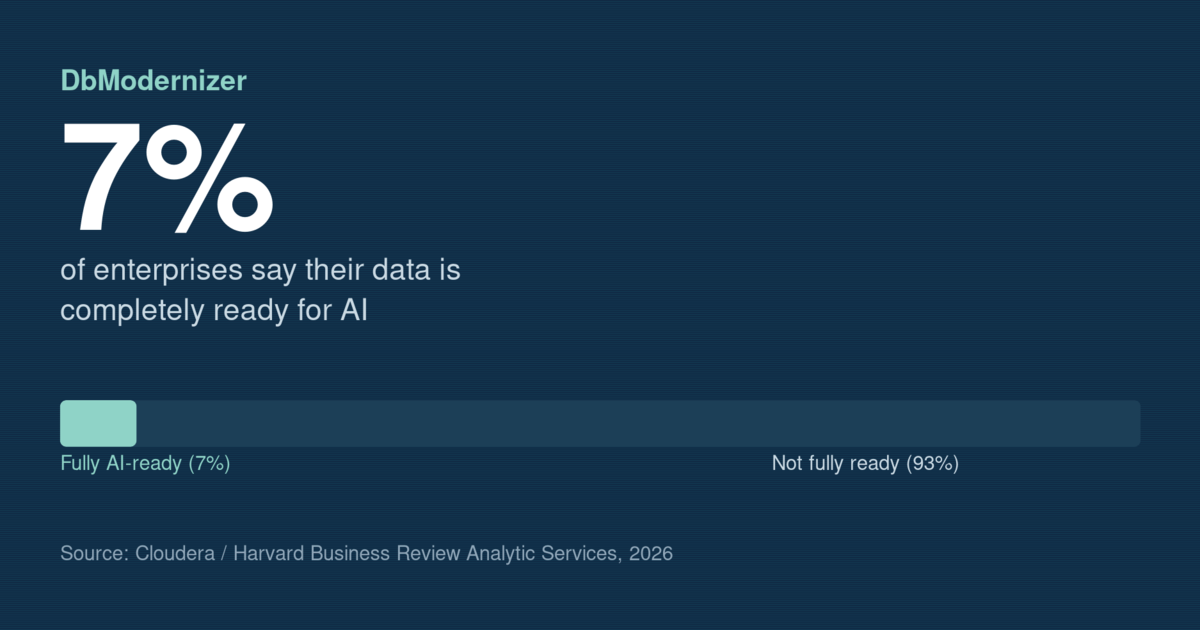
Most companies investing in AI right now don’t have a model problem. They have a database problem, and the numbers back that up: according to a 2026 report from Cloudera and Harvard Business Review Analytic Services, only 7% of enterprises say their data is completely ready for AI. A separate CIO.com survey puts it even lower — 5%, even as nearly every enterprise is actively investing.
Key takeaways
- Only 7% of enterprises report fully AI-ready data, despite near-universal AI investment
- 79% of organizations say integration challenges are hindering their AI initiatives even after significant spend
- “AI-ready” is a database engineering problem — schema design, indexing, pipelines, and access patterns — not a model or tooling problem
- The fix is usually cheaper and faster than the AI project it’s blocking, if you scope it correctly
Why the gap is so wide
It’s not that companies are ignoring AI. Writer’s 2026 enterprise AI adoption research found 79% of organizations face real challenges getting value from AI despite high levels of investment. The money is going in. The results aren’t coming out proportionally. And when you trace those stalled AI initiatives back to their root cause, the pattern is consistent: the database underneath was never built for this.
Most production databases were designed for transactional workloads — predictable queries, structured schemas, batch reporting. AI systems ask something different of them: fast retrieval over unstructured and semi-structured data, similarity search instead of exact match, pipelines that move data continuously instead of overnight, and access patterns that didn’t exist five years ago. A database can be perfectly healthy by traditional standards — good uptime, reasonable query times, clean backups — and still be nowhere close to AI-ready.
What “AI-ready” actually means at the database layer
“AI-ready data” gets used as a vague aspirational term in a lot of vendor marketing. At the database layer, it breaks down into things you can actually audit:
Indexing built for retrieval, not just reporting. If every AI feature you ship has to do a full table scan or a slow application-side join to find relevant records, you don’t have an indexing strategy — you have a workaround. Vector and hybrid search need purpose-built indexes, and most legacy schemas have none.
Pipelines that don’t break when upstream systems change. AI features are only as reliable as the data feeding them. If your pipelines are still a tangle of manually triggered scripts, every schema change upstream is a landmine for whatever’s consuming that data downstream — including your AI systems.
Schema and access changes that go through CI/CD, not tribal knowledge. If deploying a database change still means someone remembers to run a script by hand, you don’t have a modernization gap — you have a governance gap, and it’s the same gap that makes AI initiatives risky to scale.
Data quality that’s been profiled, not assumed. Garbage in, garbage out applies more brutally to AI than to a quarterly report nobody reads closely. Retrieval systems surface whatever’s actually in the data, mistakes included.
None of this requires ripping out your database and starting over. It requires treating “AI-ready” as a specific, auditable engineering target instead of a marketing checkbox.
Where to actually start
If you’re staring at that 7% figure and wondering which side of it you’re on, the fastest way to find out isn’t a full audit — it’s picking the one AI feature that matters most to the business right now and tracing its data path end to end. Where does it slow down? Where does it break? Where does someone quietly patch it by hand every week? That’s your real modernization scope, and it’s usually a lot smaller and more specific than “modernize the database.”
If your team is running into this — an AI initiative that’s stalled because the database underneath it wasn’t built for the job — that’s exactly what I help companies fix. Take a look at what a modernization engagement looks like or get in touch and we can talk through your specific setup.
Ivan Lima is a data engineer specializing in database modernization for AI systems. Get in touch if your database needs to be ready for what’s next.