Your Database Was Provisioned for Humans. Agents Just Broke the Model
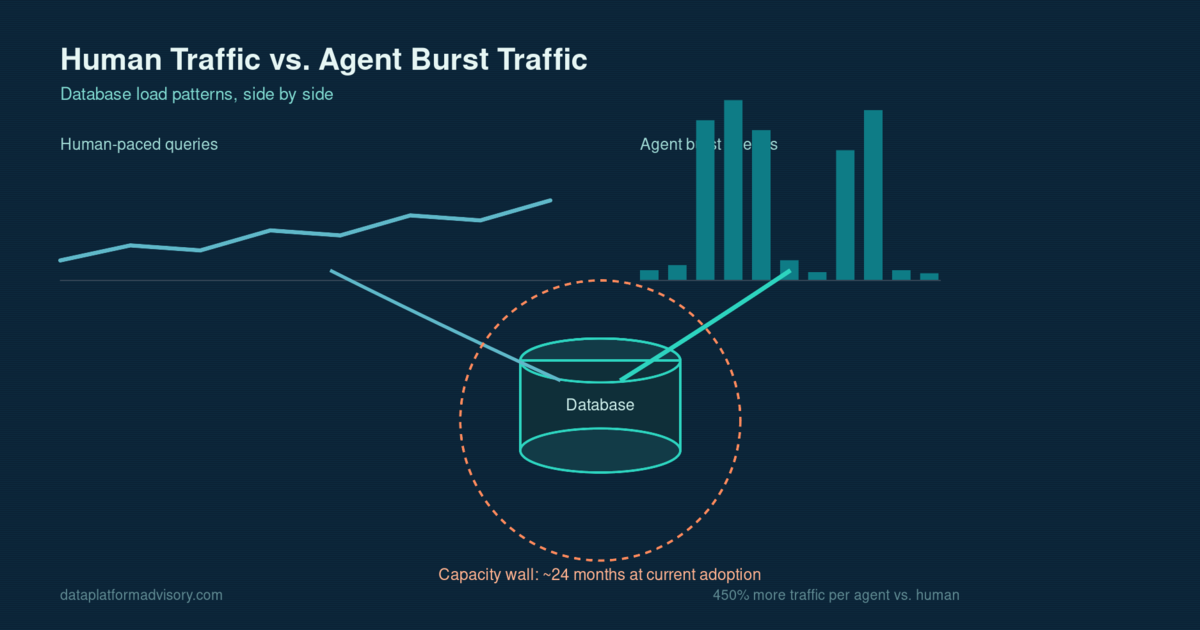
Most database capacity plans still assume a human is at the other end of every query: predictable business hours, gradual growth, traffic that ramps up over months, not milliseconds. AI agents don’t work that way. A single agent can generate up to 450% more total traffic than a human doing the same task, and it can go from idle to a chain of hundreds of queries in the time it takes a human to read a Slack message. Most enterprises will hit real capacity limits within roughly 24 months — and the ones adopting AI fastest are the most exposed.
What’s actually happening
For most of the cloud era, database and infrastructure capacity planning has been built around human-paced traffic: a person clicks, a query runs, a response renders, the person reads it before clicking again. That rhythm gave systems natural breathing room — request rates rose and fell in patterns predictable enough to provision for, autoscale around, and forecast a quarter out.
Agentic workloads break that rhythm entirely. An AI agent doesn’t wait for a human to finish reading before firing the next query. It runs continuously, calls APIs in parallel, chains actions across dozens of systems, and can sit idle for hours before suddenly triggering a burst of database calls with no ramp-up period at all. A joint 2026 study from Cisco and Foundry, “No Time to Wait: The Accelerating Impact of AI on Campus and Branch Networks,” surveyed thousands of enterprise IT leaders across 30 markets and found that a single AI agent generates up to 450% more total traffic than a human performing the same task, with roughly 70% of that traffic tied to inference calls that ultimately hit backend data systems (Cisco/Foundry study, reported by THE DAILY BRIEF). The same research found enterprise network traffic already up 34% from AI workloads at current adoption levels, with leaders expecting it to roughly triple over the next three years.
The database layer absorbs a disproportionate share of that shock. A chatbot answering one user question might issue a single query. An agent handling the same task might issue a dozen — checking state, retrieving context, validating a prior step, writing an audit log, re-checking after a tool call — and it does this at machine speed, with no natural pause between requests. Multi-agent systems compound the problem further: parallel agents updating shared state introduce write contention, cross-agent coordination queries, and telemetry ingestion volumes that most transactional databases were never tuned to sustain simultaneously with their core workload.
Who this affects
This lands squarely on the people who own database and infrastructure capacity: DBAs and platform engineers who set autoscaling thresholds and connection pool limits, infrastructure and SRE leads who own the incident response when a system falls over under unexpected load, and the CTOs and VPs of engineering who sign off on the cloud spend those systems require. It also affects data engineering leads who build the pipelines feeding agent context — those pipelines now have to keep pace with machine-speed consumers instead of human-speed ones.
It’s a mistake to file this under “someone else’s problem” because it looks like a networking or DevOps issue. The Cisco/Foundry research found campus Wi-Fi and WAN links absorb the most visible strain, but the database tier is where the burst actually lands once it clears the network — and it’s the tier least equipped to gracefully shed load, because a database can’t simply drop a write the way a network can drop a packet under congestion. A stalled or throttled query doesn’t just slow a dashboard; it can back up an entire agent workflow, and depending on the agent’s retry logic, trigger a second wave of load exactly when the system is least able to absorb it.
FinOps and cost-efficiency teams are affected too, in the opposite direction: over-provisioning “just in case” against unpredictable agent bursts is the fastest way to blow a cloud budget, since idle reserved capacity for spiky, low-average workloads is one of the most wasteful spending patterns in cloud infrastructure.
When this becomes a real problem
This isn’t a five-year-horizon risk. Some organizations are already seeing it: agent pilots that work fine in testing start producing intermittent timeouts and connection pool exhaustion once they’re rolled out against production data volumes and real concurrency. The Cisco/Foundry research puts a specific number on the broader trend — most enterprises will hit meaningful network and infrastructure capacity limits within about 24 months, not the five-year horizon most capacity plans are still built around. Separately, Gartner’s Predicts 2026 report on AI agents in IT infrastructure operations projects that roughly 70% of enterprises will deploy agentic AI in infrastructure operations by 2029, up from under 5% in 2025 — a 14x increase in four years, compressed into a window most capacity roadmaps aren’t built to absorb.
The uncomfortable pattern in the data: only about 30% of the most aggressive AI adopters report being fully prepared for the infrastructure growth their own AI roadmap implies. In other words, the companies moving fastest on agent deployment are, on average, the least ready for the load those agents generate. That’s not a coincidence — it’s what happens when AI initiatives get funded and shipped faster than the infrastructure conversation happens alongside them.
How this actually plays out in a database environment
The failure mode is rarely a dramatic outage. It’s usually quieter and more corrosive than that.
Connection pool exhaustion under burst concurrency. Traditional pool sizing assumes a bounded, roughly steady number of concurrent human sessions. An agent fleet can spin up dozens of concurrent database sessions in seconds when a workflow fans out — think a multi-step research agent parallelizing subtasks — and just as quickly release them. Pools sized for human concurrency patterns either exhaust immediately (rejecting legitimate agent requests) or, if oversized to compensate, sit mostly idle and waste licensing and compute cost the rest of the time.
Autoscaling that reacts too slowly, or overreacts. Standard autoscaling triggers on sustained metrics over a window — CPU above a threshold for 60 seconds, queue depth over N for a sustained period. That works for gradual traffic ramps. It works poorly for an agent burst that spikes and resolves inside that same window: by the time new capacity comes online, the burst may already be over, leaving the system to have absorbed the worst of it unscaled, followed by wasted capacity scaling down again minutes later. Read replicas and cache layers tuned for predictable diurnal patterns show the same lag.
Write contention from parallel agents on shared state. When multiple agents (or multiple instances of the same agent) update overlapping rows — a shared task queue, a shared customer record, a shared inventory count — lock contention and deadlocks increase in ways that don’t show up in single-agent testing. This is a genuinely new failure class: the database was consistent and performant with one agent in staging, and starts throwing deadlock errors once ten agents run concurrently in production.
Telemetry and audit-log ingestion competing with the primary workload. Agent systems generate substantially more logging and provenance data than human-driven applications — every tool call, every intermediate reasoning step, every retrieved context chunk is a candidate for logging, both for debugging and for the governance/audit requirements covered elsewhere in this series. That ingestion volume, if it lands on the same database as the transactional workload, competes for the same I/O and can degrade the primary path exactly when agent traffic is already elevated.
Scale-to-zero and serverless tiers hitting cold-start latency at the worst moment. Serverless database options are a reasonable fit for unpredictable, spiky agent workloads on paper, but cold starts after idle periods introduce latency spikes that can cascade through an agent’s retry and timeout logic, sometimes triggering redundant work that adds even more load right as the system is spinning back up.
Actions to take now
-
Instrument agent traffic separately from human traffic today. You cannot capacity-plan for a pattern you can’t see. Tag or route agent-originated database connections distinctly (via connection metadata, service identity, or a dedicated proxy layer) so burst patterns are visible in monitoring before they become incidents.
-
Load-test against realistic agent concurrency, not human-equivalent concurrency. Standard load tests modeled on historical human traffic will systematically understate agent burst behavior. Build a test profile around fan-out patterns — many concurrent sessions opening and closing in seconds — and run it against staging before the next major agent rollout, not after.
-
Audit connection pool sizing and timeout behavior for burst tolerance, not just steady-state throughput. Review whether pools reject or queue excess connections gracefully under a sudden spike, and whether application-side retry logic could turn a brief spike into a sustained overload through retry storms.
-
Separate telemetry/audit-log writes from the primary transactional path. Route agent logging and provenance data to a dedicated store or a write-optimized secondary path so it can’t degrade primary query latency during a burst.
-
Re-tune autoscaling trigger windows for burst-shaped load, not diurnal load. Shorter evaluation windows and pre-warmed standby capacity for known agent workflows will do more for burst resilience than raising a CPU threshold. Where the platform supports it, evaluate predictive or scheduled scaling ahead of known agent-triggered events (batch runs, scheduled workflows) rather than relying solely on reactive metrics.
-
Model the FinOps tradeoff explicitly before choosing serverless vs. provisioned capacity for agent-facing tiers. Serverless suits genuinely unpredictable, low-average workloads; provisioned capacity suits agent workloads that have settled into a recognizable baseline. Running the wrong choice for your actual pattern is one of the most common sources of surprise cloud spend in agent deployments — re-evaluate the choice quarterly as agent adoption scales, not once at initial rollout.
-
Put database capacity on the same roadmap as the AI initiative, not a separate one. The organizations getting burned aren’t the ones without a network or database upgrade plan — they’re the ones whose upgrade plan runs on a different clock than their AI rollout plan. Bring infrastructure and platform engineering into agent deployment planning at the design stage, not after the first production incident.
Key takeaways
- AI agents generate up to 450% more total traffic than humans doing equivalent tasks, and that traffic arrives in unpredictable bursts rather than gradual ramps.
- Most enterprises are projected to hit real infrastructure capacity limits within roughly 24 months — not the five-year horizon most capacity plans still assume.
- The most aggressive AI adopters are, on average, the least prepared for the load their own agent deployments generate.
- Database-specific failure modes include connection pool exhaustion, slow-reacting autoscaling, write contention between parallel agents on shared state, and telemetry ingestion competing with the primary workload.
- The fix starts with visibility (instrument agent traffic separately) and burst-realistic load testing — not simply provisioning more capacity across the board.
Database infrastructure that was fine for human traffic patterns needs a second look before the next agent rollout, not after the first outage. Get in touch if you want a capacity and resilience review done before that happens.
Ivan Lima is a data engineer specializing in database modernization for AI systems. Get in touch if your database needs to be ready for what’s next.