Why Your AI Agents Keep Crashing (And Why You Need a DB Architect)
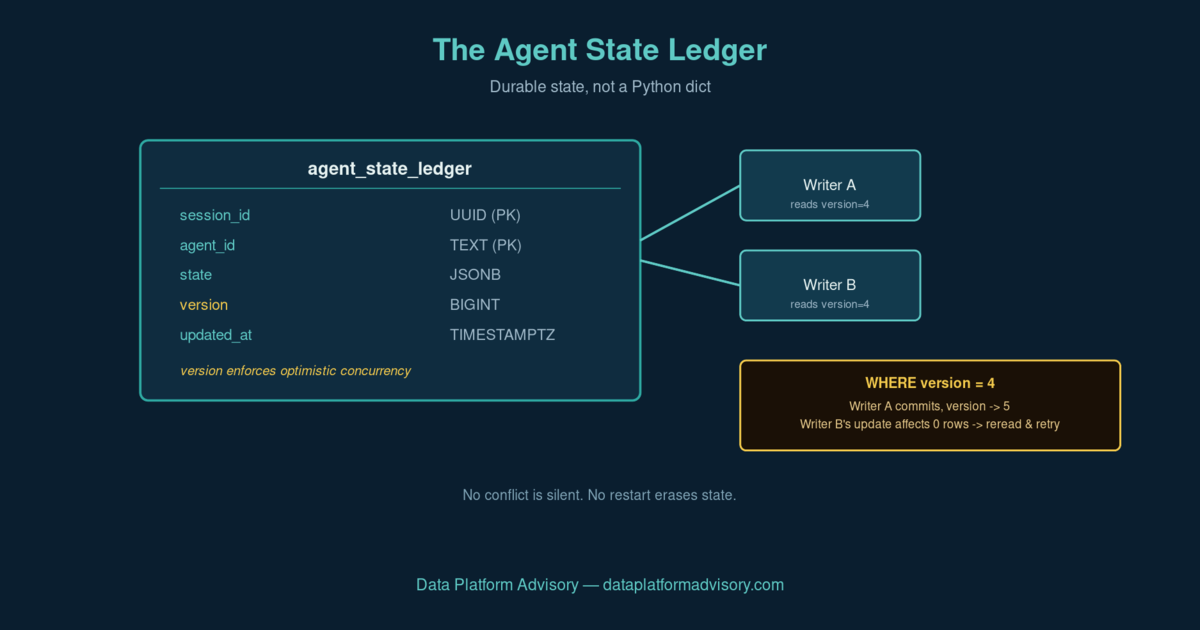
Your multi-agent system didn’t crash because LLMs are bad; it crashed because you treated memory like a temporary JSON file instead of a relational state machine. Every “agent forgot everything after a redeploy” incident traces back to the same root cause: the team building it never asked where state lives when the process dies. That’s not a prompting problem. It’s a state management problem, and it has a well-understood, decades-old answer.
The failure mode nobody wants to name
Here’s the pattern. A team ships an agent that works beautifully in the demo. It holds context across a long conversation, calls tools, updates a plan, recovers from a bad tool call. Then it goes to production, autoscaling kicks in, a pod restarts, and every bit of that context evaporates. The user has to start over. Nobody can explain why, because nobody ever wrote down where “memory” actually lived. The answer, almost every time, is a Python dictionary sitting in process RAM.
I’ve watched this exact failure take down a multi-agent workflow more than once — always the same root cause. A dict, a class attribute, an in-memory cache library with no persistence layer behind it. It works right up until the process that’s holding it doesn’t exist anymore.
This isn’t a fringe case. Reliability reviews of production agent deployments through 2025 and into 2026 consistently flag memory-related failures as the single most common category of reliability incident in agent systems — agents that forget instructions mid-task, silently lose prior context, or degrade across long sessions, because memory was never given an intentional persistence layer in the first place (Atlan). The LLM isn’t degrading. The scaffolding around it was never built to survive a restart.
Why “add retries” and “use a bigger context window” don’t fix it
The instinctive fixes are application-layer patches, and they don’t touch the actual defect.
Retries assume the failure is transient — that if you just call the model again, you’ll get a good result. But if the state you needed was never durable, retrying doesn’t recover it. You’re retrying against an empty memory, and you’ll get a coherent-sounding answer built on no history at all, which is worse than an obvious crash.
A bigger context window doesn’t solve persistence either — it solves how much state you can hold within a single running process, for as long as that process happens to stay alive. It does nothing for the moment that process restarts, gets rescheduled onto a different node, or gets killed by an autoscaler mid-request. Context window size and state durability are unrelated problems that keep getting treated as the same one.
And neither fix addresses the failure mode that’s actually more dangerous than losing memory outright: two concurrent requests corrupting shared in-memory state at the same time. Picture two workers both reading the same in-process cache entry for a session, both mutating it based on stale reads, and both writing back — the second write silently clobbers the first with no record that a conflict ever happened. No error. No log line. Just quietly wrong state that the agent will confidently act on next turn. A dict has no isolation levels, no locking, no concurrency control of any kind. It’s not a data store. It’s a variable that happens to hold data until something restarts it or two threads fight over it.
The database-first fix: the Agent State Ledger
This is where database design stops being a “nice to have” and becomes the actual missing requirement for durable agent execution. Production-grade agent workflows need explicit, externalized state, backed by a system that was built from the ground up to survive process death and handle concurrent writers correctly. That system already exists. It’s called a relational database.
Here’s the pattern I use — call it the Agent State Ledger. It’s a real Postgres schema, not a metaphor:
CREATE TABLE agent_state_ledger (
    session_id      UUID NOT NULL,
    agent_id        TEXT NOT NULL,
    state           JSONB NOT NULL,
    version         BIGINT NOT NULL DEFAULT 1,
    updated_at      TIMESTAMPTZ NOT NULL DEFAULT now(),
    PRIMARY KEY (session_id, agent_id)
);

-- Every write checks the version it read, not just the primary key.
UPDATE agent_state_ledger
SET state = $1,
    version = version + 1,
    updated_at = now()
WHERE session_id = $2
  AND agent_id = $3
  AND version = $4;   -- fails silently-safe if another writer got here first
That version column is doing the real work. PostgreSQL has no built-in optimistic locking primitive, but the pattern is simple and well-established: every table that can be written concurrently carries a version column, and every update’s WHERE clause checks that the version hasn’t moved since the writer last read it (Reintech). If the UPDATE affects zero rows, you know — deterministically, not by guessing — that a concurrent writer got there first, and your agent can reread and retry instead of silently overwriting good state with stale state.
That’s the whole fix for the corruption case. And because the table lives outside the process, a pod restart, a redeploy, or an autoscale event no longer means the agent forgot who it was talking to. The session survives because the session was never actually stored in the session.
This is post one of three on a discipline I’m calling Database-First Agent Architecture, built on three pillars: Durable State, Verified Execution, and Bounded Autonomy. This post is about the first pillar. The next two cover getting agents to stop hallucinating SQL against schemas they’ve never seen, and putting hard governance boundaries around what an autonomous agent is allowed to execute.
The analogy, if you need it
Agent memory without a database is a web server holding session state in RAM with no replication. The industry stopped doing that for web applications twenty years ago — not because it was theoretically wrong, but because it kept taking down production. Sticky sessions, lost carts, users logged out mid-checkout when a server rebooted. We solved it by moving session state into Redis, or a database, or anything external to the process. Agent frameworks are relitigating that exact mistake right now, just with a chat history instead of a shopping cart.
Practical guidance
If you’re running agents in production, or about to:
- Audit every place your agent stores “memory” and ask, specifically, what survives a process restart. If the honest answer is “nothing,” that’s your first fix, not a backlog item.
- Give every stateful table a version column and enforce optimistic concurrency on every write path, not just the ones you’ve already seen fail.
- Separate short-lived working context (safe to lose) from durable session state (not safe to lose) at the schema level, not just in code comments.
- Log every rejected write (
versionmismatch) instead of silently retrying — that log is your evidence for whether concurrent corruption is actually happening in your system. - Treat schema design for agent state as a first-class part of your architecture review, not something the application team bolts on after the demo works.
Key takeaways
- Agents that lose context on restart aren’t suffering an LLM problem — they’re suffering a state persistence problem with a known, boring, database-shaped fix.
- Retries and larger context windows patch symptoms; neither creates durability or concurrency safety.
- The Agent State Ledger pattern — session ID, agent ID, JSONB state, and a version column enforcing optimistic concurrency — gives agents state that survives process death and resists silent corruption from concurrent writers.
- This is the same lesson the web already learned with session state twenty years ago, now playing out again in agent frameworks.
- This is pillar one — Durable State — of Database-First Agent Architecture, with Verified Execution and Bounded Autonomy still to come.
If your agent architecture doesn’t have an answer for what happens on restart, it doesn’t have an architecture — it has a demo.
If your team is building agents on state that can’t survive a redeploy, that’s a schema problem before it’s a prompting problem, and it’s fixable. Get in touch or see how we approach it on our services page.
Ivan Lima is a data engineer specializing in database modernization for AI systems. Get in touch if your database needs to be ready for what’s next.