Your PQC Deadline Just Moved Up Four Years. Start With Your Database
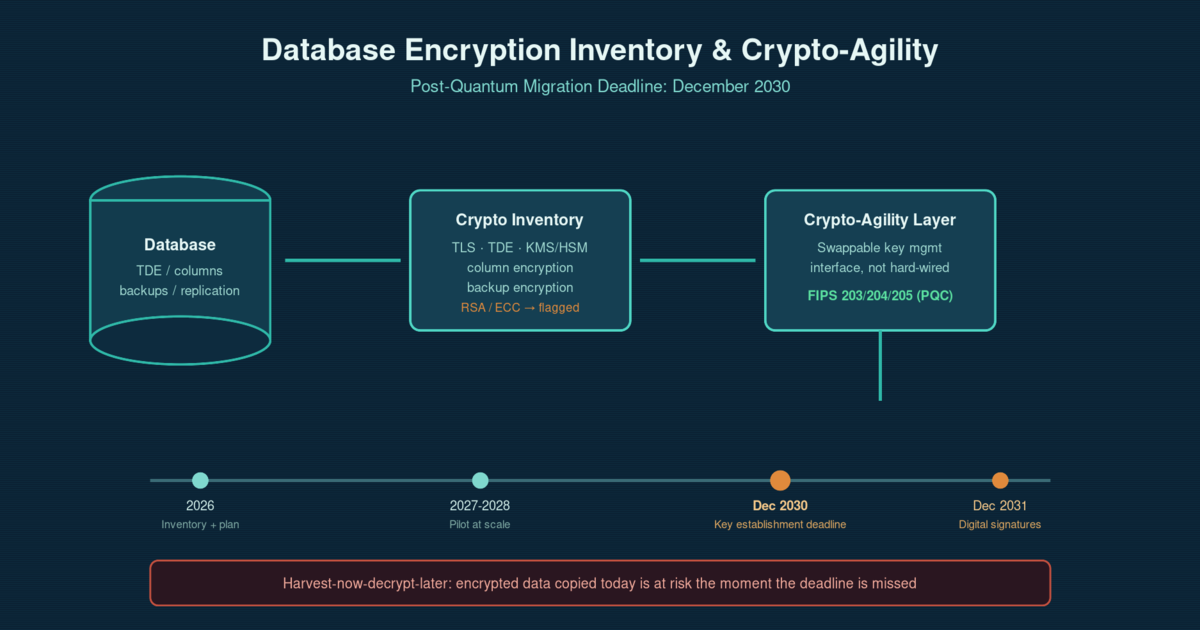
A June 2026 executive order pulled the federal government’s post-quantum cryptography deadline forward by four to five years — key establishment must be migrated by December 31, 2030, not 2035. That timeline compression matters to every database team, not just federal contractors, because the underlying threat it responds to doesn’t check who your customer is. If your database holds data that needs to stay confidential past 2030, an adversary can copy your encrypted backups today and simply wait.
What’s actually happening
On June 22, 2026, the White House signed an executive order that rewrites the government’s post-quantum cryptography (PQC) timeline. The prior target, set by 2022’s National Security Memorandum 10, gave agencies until 2035 to migrate high-value and high-impact systems. The new order splits that into two hard dates: key establishment — the cryptography that protects data in transit and at rest, including most database-level encryption — must move to quantum-resistant algorithms by December 31, 2030, and digital signatures by December 31, 2031. The Federal Acquisition Regulatory Council has 180 days to write a rule extending the December 2030 deadline to “covered contractors,” which in practice means most software and infrastructure vendors selling into government.
The order didn’t invent new cryptographic requirements — it accelerated the clock on standards that already existed. NIST finalized its first three PQC standards (FIPS 203, 204, and 205) in August 2024, and NIST Internal Report 8547 already targets 2030 for deprecating RSA and ECC — the two algorithm families underpinning the vast majority of production database encryption today, from TLS connections to transparent data encryption (TDE) key wrapping to column-level encryption. CNSA 2.0 already requires national security systems to begin adopting quantum-resistant cryptography starting in 2027. The executive order is a forcing function, not a new invention — but forcing functions are exactly what change budget priorities.
The reason this can’t wait for 2030 to become urgent is a specific attack pattern with an unglamorous name: harvest now, decrypt later (HNDL). An adversary doesn’t need to break your encryption today. They only need to copy the encrypted bytes — a stolen backup, an intercepted replication stream, an exfiltrated export — and hold them until a cryptographically relevant quantum computer exists to break RSA or ECC retroactively. Three papers published between May 2025 and March 2026 reduced the estimated quantum resource requirement to break RSA-2048 from roughly 20 million qubits to under one million, with some architectures suggesting a path toward 100,000 qubits. That doesn’t mean a quantum computer capable of the attack exists yet — it doesn’t — but it means the theoretical resource bar keeps dropping faster than most risk models assumed when they were written.
Who this affects
This is squarely a database and security leadership problem, not a cryptography-researcher problem. Three roles carry direct responsibility:
Database administrators and platform engineers own the actual encryption configuration — TDE settings, key management service integration, column-level and always-encrypted configurations, backup encryption, replication encryption. They’re the ones who will need to know, concretely, which algorithm every one of those settings currently uses, because “SQL Server handles that” or “it’s whatever the cloud provider defaults to” won’t survive a real audit.
CISOs and security architects own the crypto-agility strategy and the migration roadmap, and they’re the ones who’ll be asked by a board or a regulator whether the organization has a plan — a question that requires an inventory to answer honestly.
Compliance and legal teams own the exposure calculation for data with a multi-decade confidentiality requirement: health records, financial account data, government contract data, trade secrets, anything under a data-retention mandate that extends past 2030. If that data is sitting in a database encrypted with RSA-2048 or ECC today, its confidentiality window may already be shorter than its retention requirement.
Notably, none of this is federal-only. The FAR contractor rule extends the 2030 deadline contractually to any vendor selling into government, and the EU’s own PQC roadmap pushes member states and regulated industries to begin migration activity by the end of 2026 — well ahead of the U.S. federal timeline. If your organization sells software, holds government contracts, operates in a regulated industry, or simply stores data with a retention window past 2030, this is your timeline too, whether or not an executive order names you directly.
When this becomes real
Break the timeline into three honest phases, because overstating urgency is as unhelpful as understating it.
Already happening: HNDL collection is not a future risk — assume any sufficiently motivated adversary (nation-state actors are the most credible threat model here) is already harvesting encrypted traffic and backups today, betting on future decryption capability. This phase requires no new quantum hardware to be a live risk; it only requires that your data’s confidentiality window outlasts the arrival of a cryptographically relevant quantum computer, whenever that turns out to be.
Near-term, 2026-2028: This is the planning and pilot phase, and it’s where most organizations sit right now. NIST’s own guidance frames 2026 as the year to move from planning to pilot-at-scale. Realistically, expect vendor and platform support for PQC key establishment (database engines, cloud KMS providers, HSM vendors) to mature substantially in this window — some of it already has, some is still catching up — which is exactly why an inventory now matters more than a migration now.
2029-2031 and beyond: This is when the deadlines bite. December 2030 for key establishment, December 2031 for digital signatures, under the new federal order — with the FAR contractor rule following close behind. Estimates for when a cryptographically relevant quantum computer could actually exist remain genuinely uncertain, ranging from the early 2030s to considerably later depending on the source — but the compliance deadlines don’t wait for that uncertainty to resolve, and neither should your migration plan.
How this actually plays out in a database environment
The mechanics matter more than the deadline, because “post-quantum cryptography” is not a single switch a DBA can flip.
Database encryption touches multiple independent layers, each with its own migration path: TLS/network encryption between application and database, transparent data encryption for data at rest, column-level or “always encrypted” schemes for specific sensitive fields, backup and snapshot encryption, replication-stream encryption, and the key management layer wrapping all of the above — often a cloud KMS or on-prem HSM using RSA or ECC key exchange under the hood. A migration plan has to account for all of them separately, because they don’t upgrade together, and some (backups, especially long-retention ones) are easy to forget entirely.
The most common failure mode is not resistance to PQC — it’s the discovery step. Cryptographic discovery is consistently the most time-intensive part of a PQC program, because most organizations have never built or maintained a complete inventory of where cryptography lives in their environment — which databases, which key vaults, which third-party integrations, which legacy systems nobody has touched in years but that still hold live, encrypted, long-retention data. A database that was provisioned five years ago with default TDE settings and has quietly accumulated sensitive customer records since is exactly the kind of system that gets missed, because nobody currently owns the question “what encrypts this.”
The second failure mode is architectural rigidity: systems where the cryptographic algorithm is hard-wired into the application or database configuration rather than abstracted behind a swappable interface. That’s the absence of crypto-agility — the ability to rotate algorithms without re-architecting the system around them — and it’s what turns a PQC migration from a configuration change into a multi-quarter engineering project. Systems built without crypto-agility in mind face exactly that kind of forklift upgrade when the deadline arrives, regardless of how much runway existed beforehand.
Legacy systems compound both problems. Older database engines, on-prem HSMs nearing end-of-support, and vendor-managed encryption with no visibility into the underlying algorithm are the hardest and slowest parts of any migration — and they’re disproportionately common in exactly the industries (healthcare, financial services, government) with the longest data-retention requirements and the most HNDL exposure.
Actions to take now
Start cheap and get more specific as the deadline gets closer. None of this requires waiting for PQC database features to be fully mature — the early steps are about knowing what you have.
-
Inventory every place cryptography touches your database environment. TLS certificates, TDE key wrapping, column-level encryption, backup encryption, replication encryption, and the KMS or HSM underneath each one. This is the single highest-leverage step and the one most organizations skip. Treat it as a living document, not a one-time audit — new deployments need to be captured continuously.
-
Flag data with a confidentiality window that extends past 2030. Health records, financial account data, long-retention government or legal data, trade secrets. This is your HNDL priority list — it needs migration attention before anything else, regardless of where it sits in a broader roadmap.
-
Ask your cloud provider and database vendor what their PQC roadmap actually is. Specifically: when does their KMS support PQC key establishment algorithms, and what’s the migration path for existing encrypted data. Get this in writing, not a sales conversation — you need dates, not intentions.
-
Separate your cryptographic policy from your application code. If algorithm choice is hard-wired into schema, connection strings, or application logic instead of abstracted behind a key-management interface, that’s the crypto-agility gap that turns this into a rebuild instead of a rotation. Fixing this now, before a hard deadline forces it, is dramatically cheaper.
-
Pilot PQC key establishment on one non-critical system in 2026 or early 2027. Don’t wait for a mandate to test how your stack actually behaves with hybrid classical/PQC key exchange — vendor support is uneven right now, and you want to find the gaps on a system that doesn’t matter before you find them on one that does.
-
Build the 2028-2030 migration budget and staffing plan this year, even if execution doesn’t start until next year. Discovery and pilots are the cheap phase; production migration across every database, backup set, and legacy integration is not, and a plan written under deadline pressure is worse than one written with runway.
Key takeaways
- A June 2026 executive order moved the federal PQC deadline for key establishment from 2035 to December 2030, with digital signatures following in December 2031.
- Harvest-now-decrypt-later means encrypted data with a long confidentiality window is at risk today, even though no quantum computer can currently break RSA or ECC.
- Recent research has lowered the estimated quantum-hardware bar for breaking RSA-2048, increasing urgency without changing the fact that a cryptographically relevant quantum computer doesn’t yet exist.
- Cryptographic discovery — knowing exactly where encryption lives across TDE, column-level encryption, backups, and replication — is consistently the hardest and most time-consuming part of a PQC program, and most database teams haven’t done it.
- Crypto-agility, not any single algorithm swap, is what determines whether this migration is a configuration change or a multi-quarter rebuild.
If your database environment doesn’t have a current cryptographic inventory, that’s the actual starting line for this deadline — not the migration itself. Get in touch if you need help building one.
Ivan Lima is a data engineer specializing in database modernization for AI systems. Get in touch if your database needs to be ready for what’s next.