Your Database's Billing Minimums Weren't Built for AI Agents
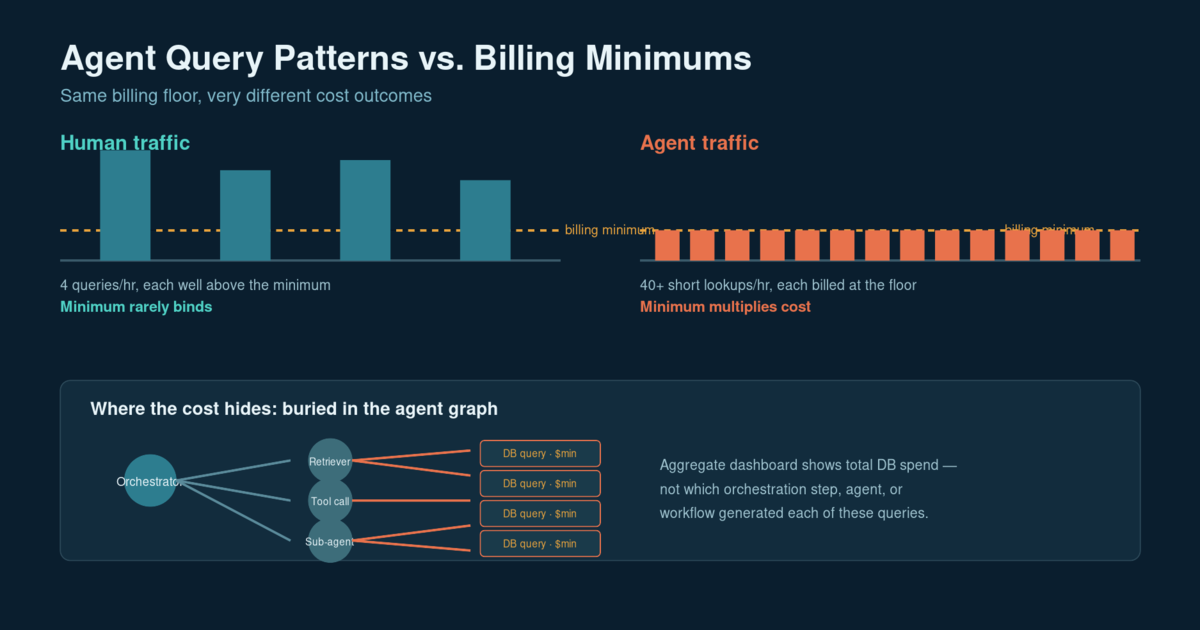
Most database and warehouse billing was built around a traffic shape that no longer describes how your systems get used: a moderate number of longer-running queries from a relatively small number of human sessions. AI agents query differently — many more requests, each shorter, arriving in unpredictable bursts — and when that pattern meets a billing model with per-query minimums or coarse-grained compute increments, the minimum itself becomes a cost multiplier nobody budgeted for. A recent review of 127 enterprise agentic AI implementations found 73% went over budget, some by more than 2.4x, and the database and data-platform layer is a disproportionate and under-tracked share of why.
What’s actually happening
Two things are colliding at once. The first is agent adoption outpacing the billing models built to meter it. McKinsey’s 2026 research on agentic AI system performance found that a large share of agentic cost — 60% in their sample — comes from response refinement and retry loops, not raw model inference, and that cost driver is frequently invisible to teams tracking aggregate spend instead of per-agent, per-query attribution. The second is that the database layer specifically has its own version of this problem: billing minimums.
Cloud data warehouses and managed databases commonly bill in fixed increments — a minimum charge per query, a minimum compute-second block, a minimum container spin-up cost — because that pricing model was designed around infrequent, longer-running human or batch workloads where the minimum rarely binds. Agent workloads invert that assumption. An agent orchestrating a multi-step task might issue dozens of short lookups per user request, each one individually trivial but each one tripping the same billing floor a much larger human-driven query would trip once. Analysis of serverless and warehouse pricing models in 2026 makes the mechanism explicit: billing minimums act as a cost multiplier that’s easy to underestimate unless total cost of ownership is calculated against actual query-duration distributions rather than average load — and agent traffic is defined by exactly the kind of spiky, bursty distribution that average-load math misses.
Layer on top of this a second, related finding: Gartner’s 2026 Hype Cycle for Agentic AI names “FinOps for agentic AI” as an emerging category in its own right — a signal that the market itself has recognized existing cost-governance tooling doesn’t cleanly cover agent-driven infrastructure spend yet. The database layer is squarely inside that gap, because most FinOps tooling built for cloud cost management was designed to allocate spend to teams and services, not to the specific agent, task, or orchestration step that triggered a given burst of queries.
Who this affects
Data platform and DBA teams own the choice of billing model, instance sizing, and query-batching strategy — the levers that actually determine whether agent traffic hits a billing minimum repeatedly or gets consolidated into fewer, larger operations. They’re also usually the first to notice the symptom (a cost anomaly on the database line item) without necessarily knowing which agent or workflow caused it.
FinOps and cloud cost teams own cost attribution and budget forecasting, and this is precisely the blind spot the FinOps Foundation’s State of FinOps 2026 report describes: AI pricing models based on tokens, inference requests, and now agent-triggered database calls don’t map cleanly onto cost-allocation frameworks built for traditional infrastructure, and 98% of FinOps practitioners are now actively working this problem compared to under a third two years ago.
Engineering leadership and CTOs own the budget line that absorbs the overrun, and they’re the ones who need to ask a question most teams currently can’t answer: what does it cost, per agent workflow, to hit the database — not what does the database cost in aggregate this month.
Product and platform teams building agent-facing features are the ones whose design choices — how chatty an agent’s tool-calling pattern is, whether it retries liberally, whether it batches lookups — directly set the query-volume dial that determines whether billing minimums matter or don’t.
When this becomes real
This isn’t a future risk — it’s already showing up in the numbers. The 73%-over-budget figure and the 2.4x overrun cases reflect implementations running today, not a hypothetical. What’s still developing is the tooling and discipline to fix it.
Already happening: any organization running agents against a metered database or warehouse today is already paying whatever premium its billing model’s minimums impose on spiky traffic — most just haven’t isolated that line item from the rest of their AI spend yet.
Near-term, 2026-2027: expect two things to mature roughly in parallel — cloud and database vendors introducing pricing tiers or batching features explicitly aimed at agent traffic patterns (some, like consumption-based serverless databases with sub-second billing granularity, already exist and are a partial answer), and FinOps tooling catching up on agent-level cost attribution, per Gartner’s naming of it as an emerging Hype Cycle category this year. Neither is fully mature yet, which means the gap between what agents cost and what teams can currently measure will likely widen before it narrows.
Longer horizon, 2028 and beyond: as agent-to-agent and multi-agent orchestration patterns become more standard (rather than single-agent-to-database), query fan-out will increase further, and billing models that haven’t adapted by then will impose a compounding, not linear, cost penalty on organizations that haven’t restructured how their databases meter agent traffic.
How this actually plays out in a database environment
The mechanism is straightforward once you isolate it, which is exactly why it’s easy to miss when you’re looking at an aggregate bill.
Take a warehouse or managed database with, say, a 10-second minimum billable compute block per query and a cold-start cost for spinning up compute if the system has been idle. A human analyst running a handful of substantial queries an hour rarely triggers that minimum in a way that matters — their queries often run longer than the minimum anyway, and the minimum is a rounding error relative to the query’s actual cost. An agent orchestrating a customer-support workflow might issue a lookup to check order status, another to check inventory, another to check a return policy table, another to log the interaction — four or more short queries, each taking a fraction of a second of actual compute, each billed at the 10-second minimum. Multiply by however many workflow steps an agent takes per user interaction, by however many interactions per hour, and the minimum — not the actual compute consumed — becomes the dominant cost driver.
This compounds with retrieval-augmented generation specifically: vector database costs scale with retrieval volume, and over-retrieval — an agent pulling more context than a task actually needs, often because prompt engineering erred toward “retrieve broadly to be safe” — generates additional similarity-search queries on top of the workflow’s core database calls, each one subject to the same minimum-billing dynamic.
The failure mode compounds further because of orchestration depth. A single user-facing request today can trigger an orchestrator, multiple retrieval calls, several tool invocations, and possibly sub-agent delegation, each layer capable of hitting the database independently and each one invisible to a cost dashboard that only shows total database spend for the month. That’s the attribution problem McKinsey’s research names directly: the cost driver is buried in the agent graph, not visible at the aggregate billing layer, which means the team that could actually fix it — by batching the four lookups into one, or caching the return-policy table lookup that never changes — often doesn’t know it needs to.
Actions to take now
Start with visibility, because you can’t fix a cost driver you can’t see, and work toward architectural changes as the pattern becomes clear.
-
Pull query-duration and query-count distributions for your database and warehouse workloads, not just monthly spend totals. Look specifically for a high volume of very short queries clustered near your billing model’s minimum threshold — that’s the signature of agent-driven billing-minimum multiplication, and most cost dashboards don’t surface it by default.
-
Tag or attribute database calls to the agent, workflow, or orchestration step that triggered them, even if it’s a rough first pass using request headers or a correlation ID threaded through your agent framework. You need per-workflow cost, not just per-service cost, to find where the multiplier is actually happening.
-
Audit for redundant or over-broad retrieval in any RAG-backed agent workflow — cases where an agent queries a vector store or lookup table more broadly, or more often, than the task strictly requires. Tightening retrieval scope is usually the cheapest fix available and doesn’t require any infrastructure change.
-
Batch what can be batched. Many multi-step agent workflows issue several small, independent lookups that could be combined into one query or one round-trip. This is standard query optimization, but it matters more now because the cost of not doing it scales with agent call volume in a way it never did with human traffic.
-
Evaluate your database and warehouse billing model against your actual (not average) traffic shape. If your provider bills in coarse minimums and your workload is agent-driven and spiky, compare it against consumption-based or sub-second-granularity alternatives — the cost delta at agent-scale query volume can be substantial, and several providers now offer pricing tiers built explicitly for this pattern.
-
Build agent-level cost attribution into your FinOps practice now, not after the first budget overrun. This is the specific gap the FinOps Foundation and Gartner are both flagging as unresolved in 2026 — getting ahead of it means your organization isn’t discovering the multiplier effect for the first time in a quarterly cost review.
Key takeaways
- A 2026 review of 127 enterprise agentic AI implementations found 73% went over budget, some by more than 2.4x, and database-layer costs are a disproportionately under-tracked contributor.
- Billing models with per-query minimums or coarse compute increments were built for infrequent, longer-running human traffic — agent workloads are the opposite shape: frequent, short, and bursty — and the minimum itself becomes a cost multiplier.
- McKinsey research attributes 60% of agentic cost to response refinement and retry behavior that’s typically invisible without agent-level, not aggregate, cost attribution.
- Gartner’s 2026 Hype Cycle for Agentic AI names “FinOps for agentic AI” as an emerging category, signaling that existing cost-governance tooling doesn’t yet cleanly cover this gap.
- The cheapest fixes — retrieval scope audits and query batching — require no infrastructure change and are available today; billing-model changes and full agent-level attribution take longer but close the gap for good.
If your database costs are climbing faster than your agent workload growth explains, that mismatch is worth investigating before it shows up as next quarter’s budget overrun. Get in touch if you want help finding where it’s hiding.
Ivan Lima is a data engineer specializing in database modernization for AI systems. Get in touch if your database needs to be ready for what’s next.