CI/CD for Databases: Why Most Teams Still Deploy Schema Changes by Hand
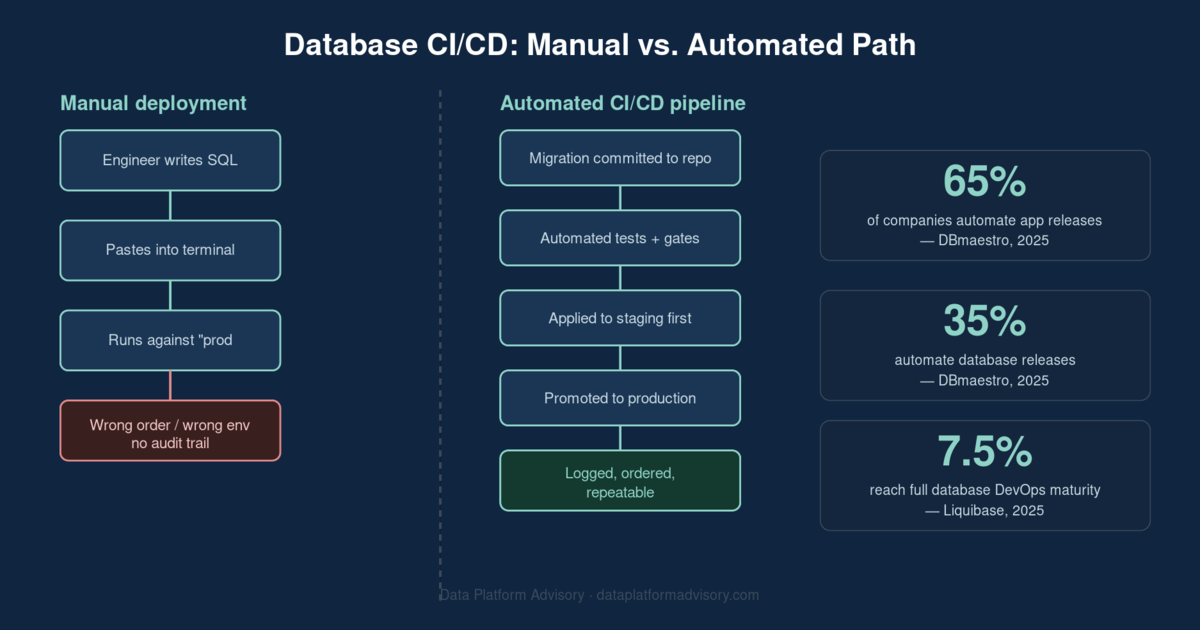
Most engineering teams automated their application deployments years ago, but the database usually didn’t come along for the ride. According to DBmaestro’s 2025 survey, 65% of companies have partial or complete application release automation, but only 35% have partially automated their database releases — and Liquibase’s State of Database DevOps 2025 report found just 7.5% of organizations have reached full database DevOps maturity, with 29% still stuck at the earliest stages. The gap between “our app deploys itself” and “our schema changes still go through a spreadsheet and a Slack thread” is one of the most common reliability risks hiding in modern data platforms.
Why schema changes resist automation
Application code is stateless in a way a database never is. You can roll back a bad application deploy by redeploying the previous container image; the old version simply replaces the new one. A database carries its state forward. If a migration adds a column, drops one, or renames a table, “rolling back” means reversing a change against data that may have already been written to the new shape. That asymmetry is real, but it’s not a reason to stay manual — it’s a reason to be more deliberate about the pipeline, not less.
The practical result is that many teams that automated everything else still run schema changes through a person: someone connects to production, pastes in a .sql file, and watches the output. It works, until it doesn’t. A migration run out of order, a change applied to the wrong environment, or a script that silently failed halfway through is not a hypothetical — it’s the single most common cause of self-inflicted database incidents.
What changes when schema deployment moves into CI/CD
A database CI/CD pipeline puts schema changes on the same footing as application code: version-controlled, tested, reviewed, and applied through an automated, repeatable process rather than a person’s hands. Concretely, that means:
- Migrations live in source control, ordered and named so the pipeline (not a person’s memory) determines what has and hasn’t been applied to a given environment.
- Every migration runs against a lower environment first — staging or a disposable copy of production — before it’s allowed anywhere near live data.
- Automated checks gate the deploy: does the migration have a corresponding rollback path, does it lock a table for longer than an acceptable window, does it touch a table without an existing backup verification.
- The pipeline logs exactly what ran, when, and against which environment — the audit trail a human-run process almost never produces reliably.
Tools like Flyway (migration-first, ordered SQL scripts) and Atlas (declarative, desired-state schema definitions) automate the mechanics; Bytebase and similar platforms add review workflows and access control on top. None of them are magic — they just remove the two things that make manual schema deployment risky: memory and improvisation.
Key takeaways
- 65% of companies have automated application releases; only 35% have automated database releases — the database is where most teams’ DevOps maturity actually stops.
- Manual schema deployment fails the same way almost every time: wrong order, wrong environment, or a silent partial failure with no clean audit trail.
- Database CI/CD doesn’t require the database to behave like stateless application code — it requires version control, staged testing, and automated gates before anything touches production.
- Liquibase’s 2025 survey found mature teams cite better visibility into changes (54%) and reduced manual workload (53%) as the top benefits — not just speed.
Where teams get stuck
The barrier usually isn’t tooling — it’s organizational. Liquibase’s report found 54% of respondents cite integration complexity as the top barrier to adoption, and 43% cite a lack of skills and training. Database changes have historically been owned by a DBA team operating outside the software engineering pipeline, with its own review process and its own tools. Folding that into a CI/CD pipeline built by and for application engineers takes real coordination, not just a new plugin.
The teams that get this right tend to start narrow: one low-risk service, one migration tool, one environment promotion path, proven out before it’s extended to the systems that actually matter. Trying to automate schema deployment for every database at once, all at once, is a good way to end up back at manual deploys after the first incident during rollout.
If your database changes still depend on someone running a script by hand, that’s not a tooling gap you can buy your way out of overnight — but it is one worth closing deliberately. Get in touch if you want help mapping out where to start.
Ivan Lima is a data engineer specializing in database modernization for AI systems. Get in touch if your database needs to be ready for what’s next.