Data Gravity Is Quietly Cloning Your Production Database
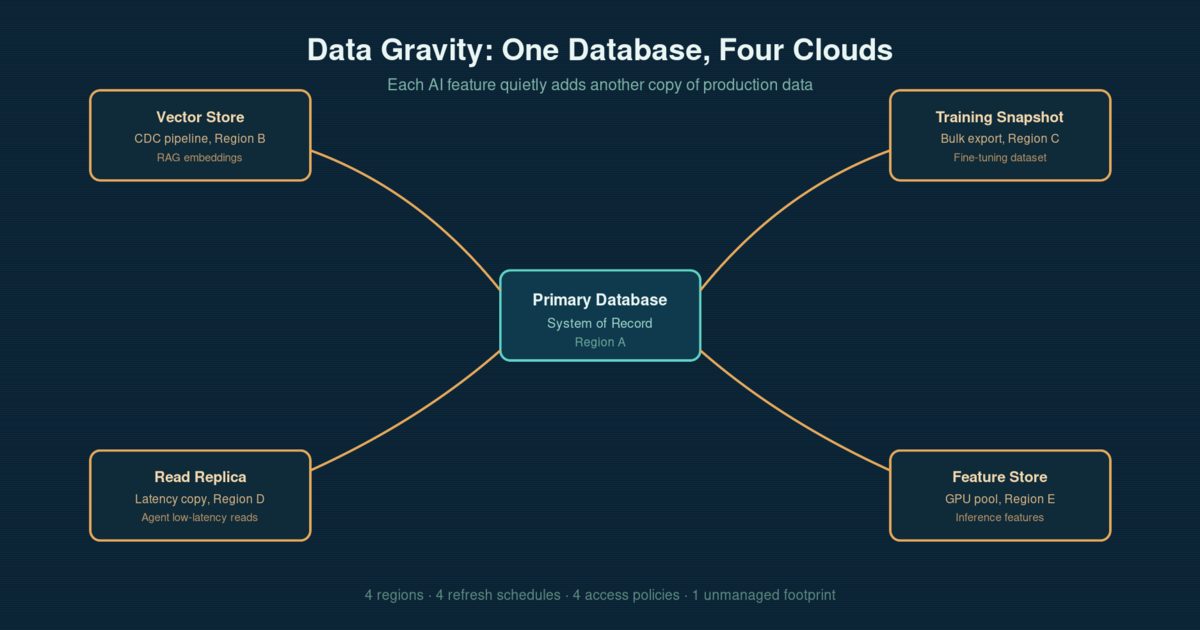
AI workloads don’t move to your data. Because moving trained models and inference stacks is far easier than moving terabytes of production data, teams building AI features are instead moving the data — standing up CDC pipelines, read replicas, and export jobs that copy production tables into whatever region or cloud their GPU capacity happens to sit in. Cast AI’s 2026 State of Kubernetes Optimization Report found average enterprise GPU utilization sitting around 5%, with most of that idle capacity a direct result of data having to be staged and replicated into place before a job can even start (Cast AI, 2026 State of Kubernetes Optimization Report). The fix teams reach for — replicate the data closer to the compute — quietly multiplies the number of copies of your production database that exist in the world, and almost nobody is tracking where they all are.
What’s actually happening
The term for this is data gravity: the more data accumulates in one place, the harder and more expensive it becomes to move, so applications and compute get pulled toward it instead. AI inverts the economics that used to keep this manageable. GPU capacity is scarce, unevenly distributed across regions and clouds, and expensive enough that teams take whatever allocation they can get — which is rarely in the same region as the production database (VAST Data, “AI Didn’t Create Data Gravity. It Made It Impossible to Ignore.”). So instead of compute traveling to data, data travels to compute — over and over, once per GPU pool, once per vector store, once per new AI feature that needs “a copy of prod” to build against.
In practice this shows up as change-data-capture pipelines feeding vector databases and feature stores, ad hoc export jobs snapshotting tables into a different cloud’s object storage for a training run, and read replicas spun up in a GPU-rich region purely for latency reasons. CDC-to-vector-store pipelines are now a standard, almost default pattern for retrieval-augmented generation: tools stream inserts and updates out of Postgres or MongoDB, generate embeddings, and push them into Pinecone, Weaviate, or Qdrant, often set up by an AI or ML engineering team with no obligation to loop in whoever owns the source database (Estuary, “Postgres CDC for AI Agents”). Each of those pipelines is a new, independently-refreshed copy of production data living outside the system of record’s access controls, retention policy, and monitoring.
None of this is malicious or even careless in isolation — it’s the fastest way to ship an AI feature under deadline pressure. A platform engineer given a GPU allocation in a region two thousand miles from the primary database, a two-week deadline, and a Slack thread instead of a change-management ticket will build a replica, not file a governance request. Multiply that decision by every AI feature shipped in the last eighteen months and the problem stops looking like a series of reasonable shortcuts and starts looking like an org-wide blind spot: nobody owns the full map of where your production data now lives, how fresh each copy is, or what it’s costing to keep feeding them.
Who this affects
DBAs and data platform teams are the ones who eventually get paged when a downstream consumer reports stale or inconsistent data, but they frequently don’t know the pipeline exists until then — it was stood up by an AI/ML team working from the source database’s read endpoint, not through the normal change-management process. Platform and infrastructure leads own the cloud bill and are the ones who discover, usually in a monthly cost review, that egress and cross-region replication traffic has become a top-five line item with no clear owner to push back on it. FinOps and cost-efficiency teams are increasingly asked to explain AI infrastructure spend where egress can reach roughly 30% of the total bill for data-intensive AI workloads, but can’t attribute it to a specific pipeline because nothing was tagged when it was created (Spheron, “GPU Cloud Egress Costs: The Hidden AI Bandwidth Bill,” 2026). Security and compliance teams inherit the least visible version of the problem: every unmanaged replica is a copy of production data, potentially including regulated fields, sitting under a different access model, in a different jurisdiction, than the one that was reviewed and approved for the source system. In regulated industries, that gap alone can turn a routine audit into a multi-week scramble.
When this becomes a real problem
This isn’t a future risk — the pipelines already exist in most organizations running any AI feature against production data; the question is whether anyone has inventoried them yet. What’s changing is the trajectory: as agentic applications multiply and GPU capacity remains scarce and geographically uneven through at least 2027, the number of “just replicate it locally” pipelines per organization is heading up, not down, with each new AI feature adding another one by default. Enterprises expect AI-driven network and data-movement traffic to roughly triple over the next three years as agent adoption scales, which means the current sprawl — already large enough to be showing up as a top cost line in some organizations — is closer to the beginning of the curve than the end of it (Cisco/Foundry, “No Time to Wait,” 2026, as reported). Organizations that wait for a cost review or a compliance audit to surface this will be inventorying a much bigger, messier footprint than the one that exists today, at a point where untangling ownership and lineage is considerably harder than it would be now.
How it actually plays out in a database environment
A typical path looks like this. A team builds a RAG feature and needs embeddings kept current, so they wire up CDC on the relevant Postgres tables, streaming changes into a vector store hosted in whatever cloud region has GPU capacity available — frequently not the region the primary database runs in. Three months later, another team needs a training dataset for a fine-tuning job and exports a broader snapshot of the same tables into cloud storage in a third region, because that’s where the training cluster was provisioned. A third team, building an agent that needs low-latency reads, spins up a dedicated read replica co-located with an inference endpoint in a fourth region. Each of these was approved locally, by the team that needed it, using credentials that were already provisioned for an existing reporting job.
Each pipeline was a reasonable, isolated decision. Collectively, the organization now has the equivalent of production data — some of it customer PII, some of it financial or health data depending on the industry — replicated across four regions, refreshed on four different schedules, governed by four different access policies, and none of it visible from a single dashboard. The failure modes compound from there: a CDC pipeline that silently stops picking up deletes leaves stale records queryable in the vector store indefinitely, since vector indexes are notorious for missing delete propagation without dedicated monitoring (Estuary, “The Data Engineer’s Guide to CDC”). A snapshot export taken for a training run outlives the project and becomes an unmonitored, unencrypted-at-rest copy sitting in object storage two years later, discovered only when a security scan flags an S3 bucket nobody remembers creating. Egress charges from replicating the same tables repeatedly across regions accumulate as a diffuse cost nobody assigns to a single owner, because no individual pipeline looks expensive — only the sum does, and sums don’t show up on any one team’s invoice.
The database team, meanwhile, is usually the last to know any of this exists, because none of it required touching the primary database’s configuration — just its read endpoint and credentials, which were already provisioned for a dashboard or a reporting job and got reused for something with a very different risk profile.
Actions to take now
- Inventory every pipeline reading from your production databases. Pull connection logs and credential usage from your primary databases for the last 90 days and identify every CDC tool, export job, or replication process you don’t already have documented. This alone typically surfaces more copies than teams expect.
- Tag and cost-allocate egress by pipeline, not by account. Most cloud billing tools can break out cross-region and cross-cloud transfer costs if traffic is tagged at creation; retrofit tags onto existing pipelines this quarter so the next cost review can actually attribute spend to the pipeline causing it.
- Require a lightweight registration step for any new CDC pipeline or export job touching a production database — owner, destination, refresh cadence, and retention period, even if it’s a single form. This is the cheapest control available and closes the “nobody knew it existed” gap going forward.
- Apply source-database access controls and retention policy to every downstream copy, not just the primary. A vector store or replica holding regulated fields needs the same access review as the system of record, regardless of which team stood it up or how quickly it was needed.
- Set expiry and review dates on snapshot exports and training-data copies at creation time. A dataset exported for a specific fine-tuning run should have a default deletion date, not live indefinitely in object storage by default.
- Audit CDC pipelines for delete propagation and lag monitoring specifically — this is the failure mode most likely to produce silent, hard-to-detect data quality problems in a downstream vector store or feature store, and it rarely trips any alert on its own.
- Evaluate distributed data-fabric or data-virtualization approaches for GPU-adjacent workloads before defaulting to full replication. Newer platforms let compute query data in place across regions and clouds without a physical copy; even where full adoption isn’t practical yet, piloting it for one high-volume pipeline can materially cut both egress cost and the number of copies in circulation.
- Bring platform, security, and FinOps into the same review for any new AI feature that will read production data — this is currently three separate conversations in most organizations, and the gaps between them are exactly where unmanaged replicas originate.
Key takeaways
- AI workloads move data to compute, not the other way around, because GPU capacity is scarce and unevenly distributed while data is expensive to move — the result is a steadily multiplying number of production database copies.
- Average enterprise GPU utilization is around 5%, largely because data has to be staged and replicated before a job can start, which is a direct driver of this replication sprawl.
- Egress and cross-region data transfer can account for roughly 30% of AI infrastructure costs, but it’s rarely attributed to the specific pipeline causing it.
- Most of these pipelines are stood up by AI/ML teams independently of the database team, so the org-wide footprint is invisible until an audit or cost review forces it into view.
- The fix isn’t banning replication — it’s inventory, tagging, shared access controls, and expiry policies applied consistently to every copy, plus evaluating data-in-place alternatives before defaulting to a new pipeline.
Getting ahead of this before it shows up as a compliance finding or a six-figure line item on next quarter’s cloud bill is a lot cheaper than untangling it after the fact. Get in touch if you need help mapping where your production data actually lives today.
Ivan Lima is a data engineer specializing in database modernization for AI systems. Get in touch if your database needs to be ready for what’s next.