Your Sensitivity Labels Are Lying to Your AI Agents
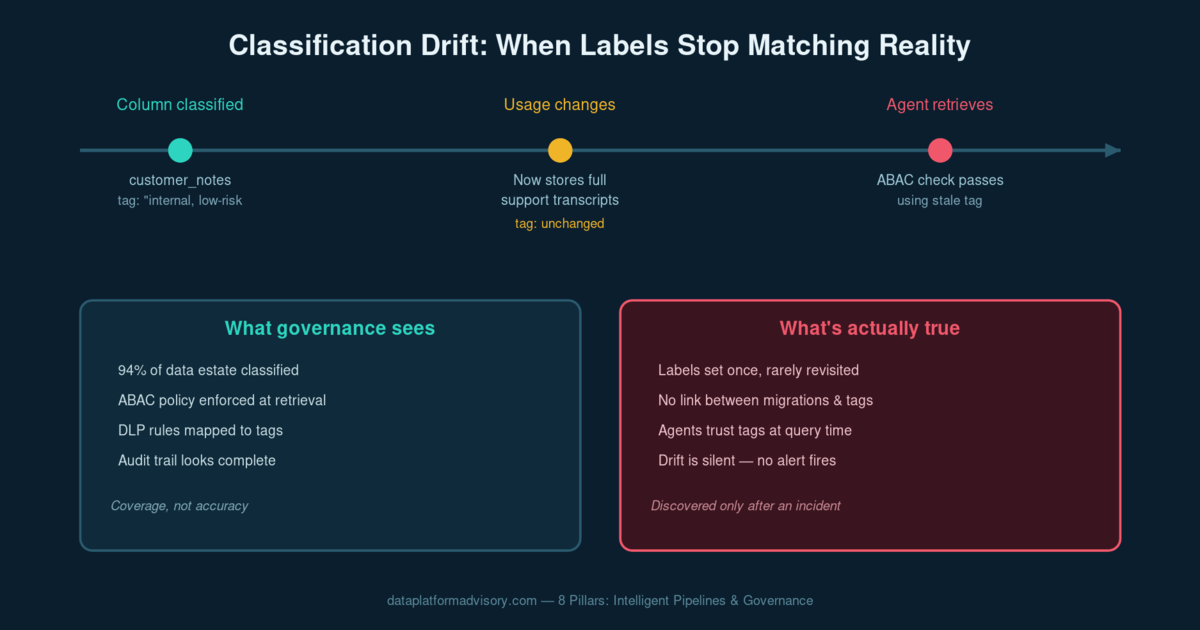
A column labeled “internal” last quarter can be exposing customer PII today, and no dashboard will flag it, because the label itself never changed — only what’s actually stored under it did. Automated classification tools tag data once and treat the tag as durable. AI agents making retrieval decisions treat that tag as ground truth. Neither assumption survives contact with a database that changes every sprint, and the gap between them is now the thing deciding what an AI agent is allowed to read.
What’s happening
Automated PII and sensitive-data classification has become standard practice, because manual, user-driven tagging simply doesn’t scale to modern data volumes — content- and context-based automated classification is now the default approach across mature governance programs (Atlan). Tools like Google Dataplex now classify sensitive data, organize metadata, and monitor lineage automatically across cloud environments, correlating classification results with access controls and risk indicators rather than leaving that correlation to a human (Kiteworks, 2026).
The problem is what these tools were built to solve versus how they’re now being used. Classification was designed as a compliance control — feeding DLP rules, access policies, and audit trails that mostly get checked periodically, by humans, on a review cadence measured in months. That cadence tolerated some staleness because the consumers of the label were slow-moving too. AI agents are not slow-moving. An agent deciding in real time whether to include a column’s contents in a retrieval-augmented response reads the classification tag once, at query time, and acts on it immediately — with no equivalent of the human reviewer who might have noticed the label looked outdated. Governance researchers now describe this explicitly as classification drift: a stale or missing label doesn’t just mislabel a file, it means every control built on top of it — access rules, DLP policies, incident response playbooks — is working from bad information, because classification was treated as a one-time project instead of a continuous process that has to keep pace with data creation (Teleskope, 2026).
The retrieval layer makes this worse, not better. Effective governance now requires attribute-based access control enforced at the point of data retrieval, where both the requesting agent’s identity and the data’s classification are checked together (Kiteworks, RAG security, 2026). That’s the right architecture — but it only works if the classification half of that check is current. An ABAC policy correctly enforcing access based on a six-month-stale label is not a working control. It’s a control that passes its own audit while failing at the one job it exists to do.
Who this affects
Data governance and compliance teams carry the most direct exposure, because classification drift undermines the exact artifact — the label — that their audit trail, DLP tooling, and regulatory reporting all depend on. A compliance report built on classification coverage percentages looks reassuring right up until an incident review reveals the labels it counted were stale. Data engineering leads and DBAs are the ones positioned to actually catch drift early, since they’re closest to schema changes — a new column, a renamed field, a repurposed table — that break the assumptions behind an existing label, but classification tooling rarely alerts engineering when a schema change might invalidate a tag; it alerts governance, on a different cadence, if at all.
Security teams building or approving agent retrieval architectures need to understand that attribute-based access control at the retrieval layer is only as trustworthy as its classification input — treating ABAC enforcement as sufficient without a parallel commitment to classification freshness creates exactly the kind of control that looks robust in an architecture diagram and fails silently in production. This is the retrieval-side counterpart to the review gap covered in A Human-in-the-Loop Framework for AI Database Code — a stale classification tag is one more artifact nobody in the pipeline is explicitly responsible for keeping current. Engineering managers greenlighting RAG or agent-retrieval projects need to budget for classification maintenance as an ongoing operational cost, not a one-time setup task the governance team handles before launch.
When this becomes a real problem
This is already a live exposure, not a future one — sensitive data exposure is the AI/LLM attack type organizations report rising fastest, and only about a third of organizations report complete knowledge of where their sensitive data actually lives (Kiteworks). Sixty-five percent of enterprises had already experienced an AI agent security incident by mid-2026, with publicly reported AI security incidents up 56.4% year over year (Kiteworks, agent incidents, 2026). Classification drift specifically compounds over time rather than announcing itself: every schema change that isn’t paired with a classification review widens the gap a little further, and because the failure mode is silent, organizations generally don’t discover how wide the gap has gotten until an agent actually retrieves and surfaces something it shouldn’t have. The realistic timeline is not “if” but “how long has this already been true” for any organization running AI-agent retrieval against a database whose classification tags haven’t been explicitly re-validated against the current schema in the last quarter.
How this actually plays out in a database environment
The mechanism is mundane, which is exactly why it’s dangerous. A table gets classified once — say, a customer_notes column tagged “internal, non-sensitive” because at the time it held short operational comments. Months later, a product change starts routing free-text customer support transcripts into that same column, because it was the closest existing field and nobody wanted to run a migration for what looked like a minor feature addition. The column’s contents changed completely. Its classification tag did not, because nothing in the deployment pipeline for that feature touched the classification system — schema migrations and classification tooling are typically separate systems with no dependency between them.
An AI agent with retrieval access to customer_notes, gated by an ABAC policy that permits broad read access to anything tagged “internal, non-sensitive,” now has standing access to what is functionally unredacted customer support transcripts — potentially including account details, complaints referencing other systems, or personal circumstances customers disclosed to a human agent, never anticipating it would be classified as low-sensitivity and fed into an LLM’s context window. Nothing in this chain required an attacker, a misconfiguration in the traditional sense, or a bypassed control. Every system did exactly what it was told, using information that was correct when it was set and false by the time it mattered.
There’s a second-order effect worth naming explicitly: classification drift doesn’t just create individual exposure incidents, it erodes the credibility of the entire governance program once discovered. A team that’s spent a year reporting “94% of our data estate is classified” to auditors and leadership is reporting a number about coverage, not accuracy — and the two get conflated constantly. Once one stale-label incident surfaces, the reasonable next question from any auditor, regulator, or board member is “how many of the other 94% are also wrong, just not yet discovered.” Rebuilding trust in a classification program after that question gets asked is far more expensive than maintaining classification freshness would have been in the first place, and it happens at the worst possible time — during or immediately after an incident, when leadership attention and patience are both already spent.
Actions to take now
- Inventory which classification tags in your environment have never been re-validated since initial creation. Most classification tools can report tag age; treat anything older than a schema-change cycle for that table as unverified, not trusted.
- Wire classification review into your schema-migration pipeline, not just your governance calendar. Any migration that adds a column, repurposes an existing one, or changes what an application writes into a field should trigger a classification re-check as part of the same change, not a separate quarterly audit months later.
- Treat ABAC enforcement at the retrieval layer as necessary but not sufficient. If you’ve implemented attribute-based access control gating agent retrieval by classification, confirm — explicitly, in writing — what process keeps the classification half of that equation current. If the honest answer is “nothing, yet,” that’s your highest-priority gap.
- Run a targeted audit specifically on free-text and semi-structured columns, since these are the columns most likely to silently change in character over time (a notes field, a comments field, a catch-all JSON blob) without triggering any schema alert that would prompt reclassification.
- Give data engineering, not just governance, explicit ownership of a subset of classification maintenance — specifically, the trigger condition (“this schema change may invalidate this tag”), even if governance retains ownership of the actual classification decision. The people closest to schema changes are the ones positioned to catch drift early; make that formal instead of hoping it happens informally.
- Log classification-tag age alongside every AI agent retrieval decision, so that if an incident does occur, the investigation can immediately answer “how stale was the label this decision relied on” instead of discovering that fact weeks into a postmortem.
- Pilot continuous, AI-assisted reclassification on your highest-risk tables first — tools that monitor for schema and usage-pattern changes and reclassify automatically are maturing quickly, but validate them against tables you already understand well before trusting them on tables where classification failure would be most costly.
Key takeaways
- Automated data classification tags are widely treated as durable, but classification drift — labels that go stale as schemas and data usage evolve — means the controls built on those labels quietly stop working.
- AI agents making real-time retrieval decisions trust classification tags at query time with no equivalent of the periodic human review that made staleness tolerable in older governance workflows.
- Attribute-based access control at the retrieval layer is architecturally correct but only as trustworthy as the classification input feeding it — a common blind spot in RAG and agent-retrieval security design.
- The failure mode is silent: no error, no alert, just an agent correctly following a policy built on incorrect information.
- Fixing this requires tying classification review to schema-change events, not just calendar-based governance audits.
Classification drift is a governance problem that only becomes visible at the database layer, where schemas actually change. Get in touch if you want a real assessment of how current your data’s classification actually is, not just how complete your coverage looks on a dashboard.
Ivan Lima is a data engineer specializing in database modernization for AI systems. Get in touch if your database needs to be ready for what’s next.