Replication Lag Is Poisoning Your AI Agents' Context
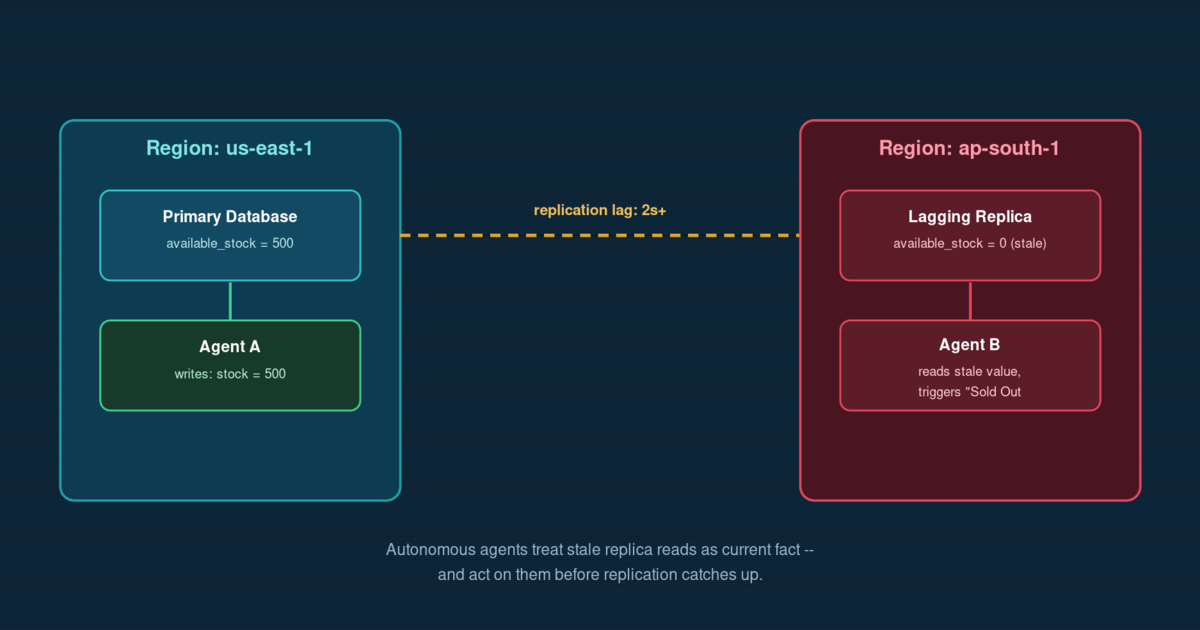
Replication lag between a primary database and its read replicas has always been a known, manageable tradeoff – a few hundred milliseconds nobody but an SRE ever noticed. Autonomous AI agents change that calculus completely. An agent that reads a stale replica doesn’t notice the data is old; it treats whatever comes back as current fact and reasons forward from there, often taking an irreversible action before anyone catches the mistake. The infrastructure pattern that quietly worked for a decade of human-facing web apps is now a direct channel for agents to act on wrong information at machine speed.
What’s happening
The mechanism is simple and has nothing to do with model quality. In a distributed database, writes land on a primary node and propagate to read replicas asynchronously, with lag that’s typically sub-second within a region and 50-200 milliseconds or more across regions depending on distance and network conditions. For a human refreshing a webpage, a stale read that resolves in half a second is invisible. For an autonomous agent, that same stale read is what AWS senior technical account manager Suman Chatterjee calls “silent poison”: the agent writes a decision to the primary, immediately reads from a lagging replica, and treats the outdated value as ground truth, then executes a multi-step plan built entirely on a fact that was already wrong (AWS Architecture Blog, “Consistency is the new latency,” Aug 2026).
This isn’t theoretical. On July 21, 2026, the engineering team at incident.io published a detailed account of exactly this failure mode: after moving background workers to read from a Postgres read replica, they saw intermittent not-found errors on roughly 0.1 to 0.5 percent of reads that immediately followed a write. The replica wasn’t unhealthy or falling behind on average – the race condition was that the gap between publishing a queue message and a worker picking it up was occasionally shorter than the replication lag itself, so the row existed on the primary but hadn’t arrived on the replica yet (incident.io, “Don’t add a read replica until you’ve read this,” Jul 2026). A human-facing system absorbed that as a rare, forgivable glitch. Point the same architecture at an autonomous agent and every one of those misses becomes a decision made on a fact that doesn’t exist yet.
The stakes get worse once an agent writes its (wrong) conclusion back to the database. A separate fintech case from earlier in 2026 found that a 2-second change-data-capture lag meant an AI-driven ad system was making decisions on creative-asset data that was already stale by the time it acted – in a domain where 2 seconds is, functionally, a lifetime. Once an incorrect conclusion is persisted, future retrievals treat it as history, and the error compounds instead of resolving itself.
Who’s affected
This lands hardest on three groups. DBAs and platform engineers own the replication topology and are the only people positioned to know, region by region and table by table, which reads are eventually consistent and which aren’t – a fact that’s rarely documented anywhere an application team can see it. AI/ML and agent-platform engineering teams are the ones wiring agents directly to read replicas for cost and latency reasons, usually without knowing which consistency guarantee they’re actually getting, because the client library abstracts it away. CTOs and engineering leaders running multi-region deployments for global agent products (customer support agents, inventory and pricing agents, fraud and compliance agents) are the ones who inherit the business damage when an agent takes a wrong, hard-to-reverse action – cancelling an order that wasn’t actually out of stock, approving a transaction a fraud check would have blocked a second later, or telling a customer something that was true two seconds ago and isn’t anymore.
Notably, this is not primarily a model problem, and prompt engineering doesn’t fix it. Large language models have no temporal compass of their own; they cooperatively treat whatever the database hands them as current, which is exactly why the AWS post frames this as an architecture responsibility rather than a model one.
When this becomes urgent
This is already happening, not a future risk. The incident.io case, the fintech CDC-lag case, and AWS publishing an architecture-level warning about it in August 2026 are all signs that this moved from edge case to recognized failure pattern within the last year. What’s changing over the next 12-24 months is scale: as more production systems move from single-agent chatbots to fleets of autonomous agents making concurrent reads and writes across regions – the pattern this site’s Cloud-Scale Infrastructure and Intelligent Resiliency pillars both track – the number of read/write pairs that can race against replication lag grows combinatorially, not linearly. A single agent hitting a stale replica occasionally is a bug. Ten agent instances per customer, each reading and writing across three regions, is a statistical certainty that some fraction of decisions every day are built on poisoned context, whether or not anyone notices.
How it actually plays out
The mechanics matter because they determine where you can intervene. Three patterns show up repeatedly in production:
The read-your-own-writes failure. An agent updates a row on the primary in us-east-1, then immediately issues a follow-up read that gets routed to a replica in ap-south-1 that hasn’t caught up. The agent sees the pre-write value and reasons as if its own action never happened – the AWS post’s flash-sale example is a textbook case: an inventory agent sets stock to 500 units, a second agent instance in another region reads 0 from a lagging replica, and triggers a “sold out” notice for a warehouse that’s actually full.
The lost-update failure. Two agent instances read the same record concurrently, each computes a decision based on that snapshot, and both write back – with the second write silently overwriting the first agent’s reasoning rather than surfacing a conflict. Without a conditional write (a version check or ConditionExpression-style guard), neither agent ever learns its decision was discarded.
The hallucination-debt failure. An agent’s wrong decision, once written back to the database, becomes the “ground truth” the next retrieval pulls into context. Unlike a one-time bad answer, this error persists and compounds: every subsequent agent that reads that row inherits the mistake as established fact, and nothing in a standard RAG pipeline flags it as suspect.
All three failures share a root cause: connection pools and ORMs default to routing reads to whatever replica is fastest or least loaded, with no consistency guarantee attached, and most agent frameworks inherit that default without anyone deciding it was the right call for an autonomous, action-taking workload.
Actions to take now
-
Inventory which agent-facing queries are consistency-sensitive. Not every read needs strong consistency – a conversational-history lookup can tolerate staleness that an inventory check or a permissions check cannot. Classify agent queries into “must be current” and “can be eventually consistent” before touching any infrastructure.
-
Audit your current read routing. Check whether your connection pooler, ORM, or agent framework is routing agent reads to replicas by default, and whether anyone chose that deliberately. Most teams find this was an inherited default from the human-facing app the agent was bolted onto, not a decision made for the agent’s workload.
-
Add read-your-own-writes guarantees for write-then-read agent patterns. If an agent writes and then needs to read that same data within the same task, route that specific read to the primary, or use a session-consistency mechanism (Aurora Global Database’s
SESSIONconsistency level, or a sticky-session pattern) rather than trusting the load balancer’s default. -
Use conditional writes to catch lost updates. For any table multiple agent instances can write to concurrently, add a version or timestamp check to every write (DynamoDB’s
ConditionExpressionpattern is the reference implementation) so a stale write fails loudly instead of silently overwriting a more recent one. -
Match your replication model to the task, not the database default. For identity, permissions, and financial state, evaluate synchronous-consistency options like Aurora DSQL or a
GLOBALconsistency level rather than accepting whatever your existing global database’s default replication mode happens to be. -
Instrument replication lag as an agent-facing SLO, not just an ops metric. Alert when lag exceeds the threshold where an agent’s reasoning window could plausibly race ahead of replication – not just when it crosses a generic ops threshold that was tuned for human-facing latency tolerance.
-
Build a poisoned-context rollback path. Because agent errors get written back as “history,” you need a way to identify and correct records an agent wrote based on data later found to be stale, not just prevent the read in the first place. Treat this the same way you’d treat a data-quality incident, with a defined remediation runbook.
Key takeaways
- Replication lag that was invisible to human users becomes a direct correctness bug once autonomous agents read and act on the data, because agents treat any value they retrieve as current fact.
- This is documented in production today: incident.io’s July 2026 postmortem and a 2026 fintech CDC-lag incident both show real agent-facing systems acting on data that was already stale.
- The failure compounds over time through “hallucination debt” – once an agent writes a wrong conclusion back to the database, future reads treat it as established history.
- The fix is architectural, not a prompting or model change: classify queries by consistency need, add read-your-own-writes guarantees, and use conditional writes to catch concurrent-agent conflicts.
- As agent fleets scale from one instance to many per customer across multiple regions, the number of read/write races grows combinatorially, making this an increasingly urgent infrastructure decision rather than an edge case.
This failure mode compounds with two other infrastructure gaps this series has covered: the data-gravity problem of shadow replicas spun up for AI compute and the thundering-herd resiliency risk of concurrent agent fanout – all three stem from infrastructure originally sized and tuned for human traffic patterns, not autonomous agents reading and writing at machine speed.
Getting agent-facing replication right is a cloud-scale infrastructure decision that has to be made deliberately, table by table, rather than inherited from whatever your web app’s connection pool was already doing. If your database’s replication topology hasn’t been reviewed since agents started reading and writing to it, get in touch – this is exactly the kind of gap that’s cheap to close before an agent acts on it and expensive to unwind after.
Ivan Lima is a data engineer specializing in database modernization for AI systems. Get in touch if your database needs to be ready for what’s next.