Why Most SQL Server Modernization Projects Fail Before AI Even Begins
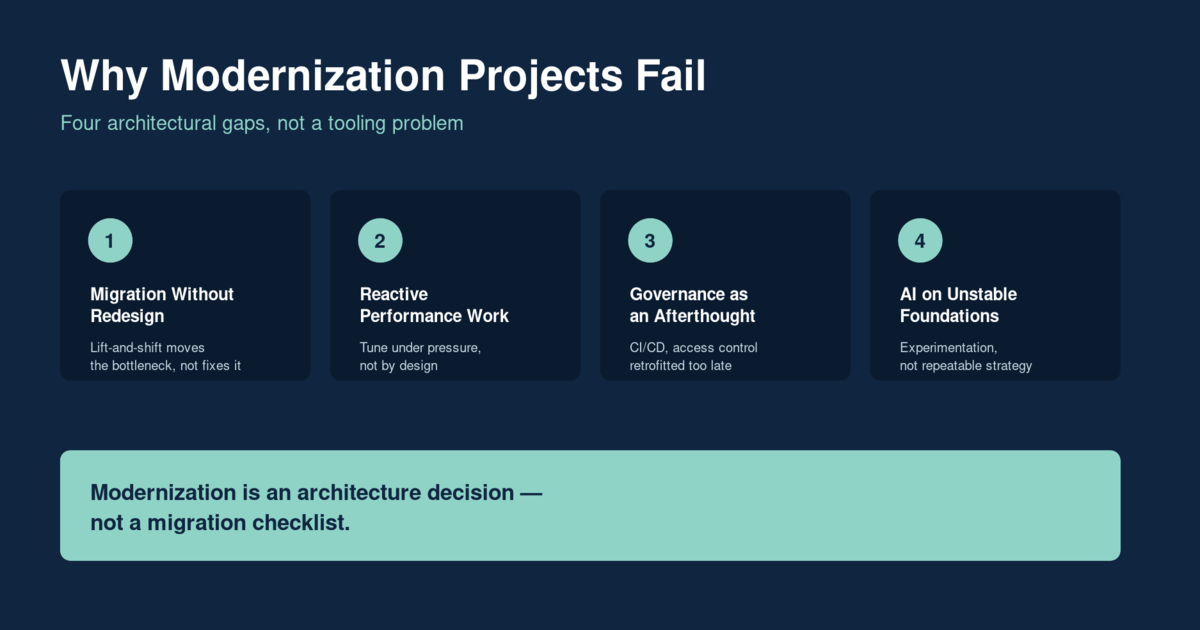
Most SQL Server modernization projects fail for one of four reasons: the team treats cloud migration as if it were modernization, performance engineering stays reactive instead of built-in, governance is added after the fact instead of from day one, or AI gets layered onto a database that was never structurally ready for it. None of these are tooling problems — they’re architectural decisions made (or skipped) early, and they compound.
Key takeaways
- Lift-and-shift to Azure is not modernization — it moves the bottleneck, it doesn’t remove it.
- Reactive performance tuning (wait for the alert, then fix it) collapses under the throughput AI workloads demand.
- Governance — CI/CD, access control, schema discipline — has to be architected in, not retrofitted.
- AI initiatives built on unstable data foundations become expensive experiments, not repeatable strategy.
1. Migration Without Architectural Redesign
Cloud migration does not equal modernization. Simply lifting and shifting SQL Server workloads to Azure without redesigning architecture patterns leads to persistent performance bottlenecks, poor cost efficiency, scaling limitations, and governance gaps that just move with the workload.
Modernization requires intentional architecture evolution, not infrastructure relocation. If nothing about how the data is indexed, partitioned, or accessed changes, the migration mostly changes where the same problems run.
2. Performance Engineering Is Treated as Reactive
Many environments operate in a reactive performance model: wait for alerts, tune queries under pressure, add hardware when latency rises. That model works — barely — for predictable, human-driven traffic.
True modernization integrates performance engineering into platform design from the beginning: indexing strategy, query patterns, and workload isolation decided up front, not discovered during an incident. Without that performance maturity, AI initiatives collapse under inconsistent data throughput the first time load gets unpredictable.
3. Governance Is an Afterthought
CI/CD governance, access control strategy, schema discipline, and deployment maturity determine long-term platform stability. Without governance built in from the start: technical debt accelerates, release cycles become unstable, security posture weakens, and executive trust in the platform erodes.
Modernization has to address operational maturity alongside architecture — a fast database that nobody can safely change isn’t actually modernized.
4. AI Readiness Requires Structured Foundations
Organizations frequently attempt AI initiatives on top of unstable data systems. Real AI readiness requires clean schema design, predictable performance, data integrity controls, and infrastructure observability.
Without those foundations, AI becomes experimentation rather than strategy — impressive in a demo, unreliable in production, and expensive to keep patching by hand.
The pattern across all four
Every one of these failure modes shows up in a different pillar of the same platform: architecture and infrastructure, automated operations, governance, and semantic/AI readiness. Organizations that align modernization with performance engineering, governance maturity, and AI readiness from the beginning build scalable foundations. Those that treat modernization as migration alone accumulate new technical debt in a different environment — just with a bigger cloud bill attached.
If you’re trying to figure out which of these four your organization is actually facing, the database modernization checklist for CTOs is a good place to start, or get in touch and we can walk through your specific setup.
Ivan Lima is a data engineer specializing in database modernization for AI systems. Get in touch if your database needs to be ready for what’s next.