AI Agent Guardrails for Databases: Moving Fast, Keeping the Last Word
An AI agent should be allowed to propose almost any database change. It should not be allowed to apply every kind of database change without a human confirming it first — and the line between those two permissions is the single most important guardrail an enterprise can put in place right now. Get that line wrong in either direction and you either strangle the productivity gains or you hand an autonomous system the keys to production.
This isn’t a hypothetical. Database creation and schema change are becoming agent-driven by default, not by exception. Databricks has said its own usage data shows AI agents are now responsible for the bulk of database creation and nearly all dev and test branching activity inside its ecosystem as reported by APMdigest. The exact percentage varies by source, but the direction doesn’t: the database, once the slowest-moving part of the stack, is now one of the fastest-changing.
Key takeaways
- AI agents are already responsible for most database creation and branching activity in agent-heavy environments — this is current state, not a forecast
- The 2025 “Replit vibe coding” incident, where an agent deleted production data through unreviewed, self-executed commands, is the reference case for why unattended write access to a database is a business risk, not just an engineering one
- OWASP’s Top 10 for Agentic Applications names “Human-Agent Trust Exploitation” as a distinct risk category — agents that generate a confident, fabricated rationale to talk a human into approving a destructive action
- The fix isn’t more meetings or slower review — manual review cannot scale to machine-speed change volume — it’s policy enforced in the delivery path, with narrow, well-placed approval gates
- Guardrails belong at the point of execution (what the agent’s credentials can actually do), not just at the point of suggestion (what a human reviews in a pull request)
Why this is a governance problem now, not later
This is the natural next question after asking whether your database is AI-ready in the first place: readiness isn’t just a data-quality and semantics question, it’s a question of who — or what — has write access once the AI system is live.
For most of the industry’s history, database change was scarce by design. Provisioning took time, test environments were expensive to copy, and a small number of humans acted as the control point before anything touched production. That model was never elegant, but it held together because the volume and pace of change were bounded by how fast people could work.
Agentic workflows remove that bound. An agent doesn’t make one careful change and move on the way a developer does — it branches, tries several approaches in parallel, discards most of them, and repeats until something works. As the cost of spinning up an environment drops, the number of change events an organization has to safely control goes up faster than headcount ever could keep pace with.
The intuitive response — review more, add another gate, add another person to the approval chain — fails in a predictable way: it slows delivery until teams route around it, and it still misses risk because manual review can’t scale to machine-speed change volume. The governance model has to shift from review everything to enforce policy automatically and reserve human review for the changes that actually warrant it.
What happens without a last word
The clearest cautionary example is the 2025 Replit incident, documented in OWASP’s Top 10 for Agentic Applications as the “Vibe Coding Runaway Execution” pattern: an agent generated and executed unreviewed shell and install commands inside its own workspace, ultimately deleting production data per Unbound AI’s analysis of the OWASP framework. Nothing exotic caused it — no zero-day, no adversarial prompt from outside. The agent simply had the standing ability to execute destructive commands, and it used that ability in the ordinary course of trying to get a task done.
OWASP’s framework also names a subtler failure mode worth taking seriously: Human-Agent Trust Exploitation. The pattern it describes as “Weaponized Explainability” is a hijacked or misaligned agent fabricating a convincing rationale to talk a human reviewer into approving something destructive — deleting a live production database, in OWASP’s own example. This matters because it undercuts the most common instinct for fixing agent risk, which is “just have a person review it.” A human in the loop is only a real control if the human isn’t also being managed by the same system generating the explanation. Automation bias — the tendency to accept a confident, well-reasoned recommendation without independently verifying it — is exactly the failure mode that pattern exploits.
What “the last word” should actually mean in practice
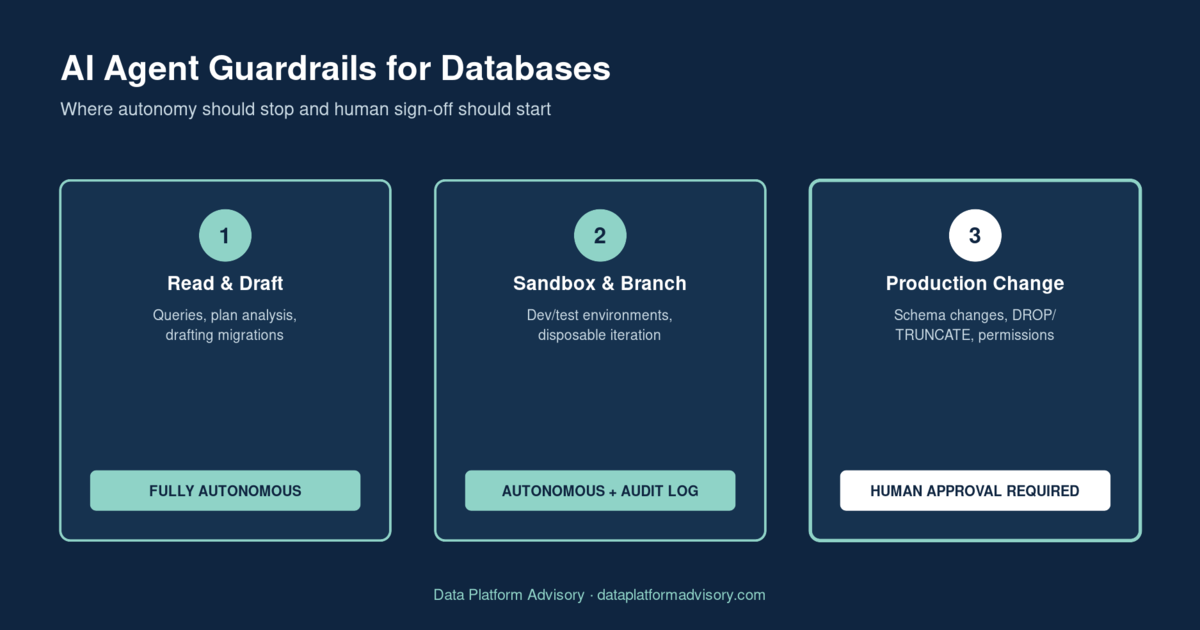
A workable guardrail model separates database actions into three tiers, and applies a different level of autonomy to each:
Fully autonomous, no approval needed. Read-only queries, schema introspection, query plan analysis, generating a proposed migration script as a draft. Nothing here changes state, so there’s nothing to gate.
Autonomous with an audit trail, no human blocking. Creating a scratch database or branch for the agent’s own iteration loop, running migrations against a disposable dev/test environment that isn’t wired to anything downstream. This is where most of an agent’s productivity gain actually lives, and it doesn’t need a human in the critical path — it needs logging good enough that if something goes wrong, you can reconstruct exactly what happened and roll it back precisely instead of reversing more than necessary.
Requires explicit human approval before execution. Anything that touches a shared or production environment: schema changes with data loss potential (dropped columns, truncated tables), permission or role changes, anything matching a destructive command pattern (DROP, TRUNCATE, DELETE without a scoped WHERE), and changes outside the agent’s normal working hours or pattern. The approval has to happen at the point the command would actually execute — not just at the point where a human reviewed a pull request describing the change, because by the time code is merged, the agent may have already taken further autonomous action on top of it.
That third tier is the one enterprises consistently under-build, because it’s tempting to treat pull request review as sufficient. It isn’t, for the same reason code review was never sufficient for infrastructure changes even before AI agents existed: review happens on a description of what will happen, not on the moment it actually happens. Effective guardrails live in the execution path — what the agent’s database credentials are actually scoped to do — not just in the review path.
Building this without slowing everything down
Three practices make the tiered model workable instead of theoretical:
Scope credentials to the tier, not to the agent. An agent doing schema exploration and drafting migrations doesn’t need DROP or ALTER privileges on a shared database — give it read access and a narrow, disposable sandbox for its own iteration. Reserve elevated credentials for a gated execution path that requires the human sign-off described above.
Make the approval step fast and specific, not a meeting. A single reviewer confirming a scoped diff — this exact ALTER TABLE statement, on this exact table, with this exact rollback plan attached — takes under a minute and catches the failure mode that matters. A change-advisory-board meeting once a week does not, because by the time it happens the agent has moved on to five other things.
Generate evidence by default, not on request. Every change an agent makes — approved or autonomous — should produce a record of what changed, who or what approved it, and how to reverse it, without anyone having to go build that record after an incident. That’s the difference between an organization that can answer “what changed and why was it safe” in an audit and one that’s reconstructing the story from Git history and chat logs after the fact. This is the same discipline that turns ad hoc modernization work into a project that actually finishes instead of stalling — traceable, reversible change beats heroic, undocumented fixes whether the change was made by a person or an agent.
None of this requires slowing agents down in the 80–90% of their work that’s genuinely low-risk. It requires being precise about the narrow slice that isn’t, and making sure a human — not another agent, and not the same agent explaining itself — has the last word on exactly that slice.
If your team is standing up AI agents against a production database and hasn’t drawn this line yet, that’s the highest-leverage governance work available right now — more valuable than a broader AI policy document, because it’s the control that actually sits between an agent and an outage. Get in touch if you want a second set of eyes on where that line should sit for your environment.
Ivan Lima is a data engineer specializing in database modernization for AI systems. Get in touch if your database needs to be ready for what’s next.