AI Isn't Replacing DBAs; It's Upgrading Us to Agent Orchestrators
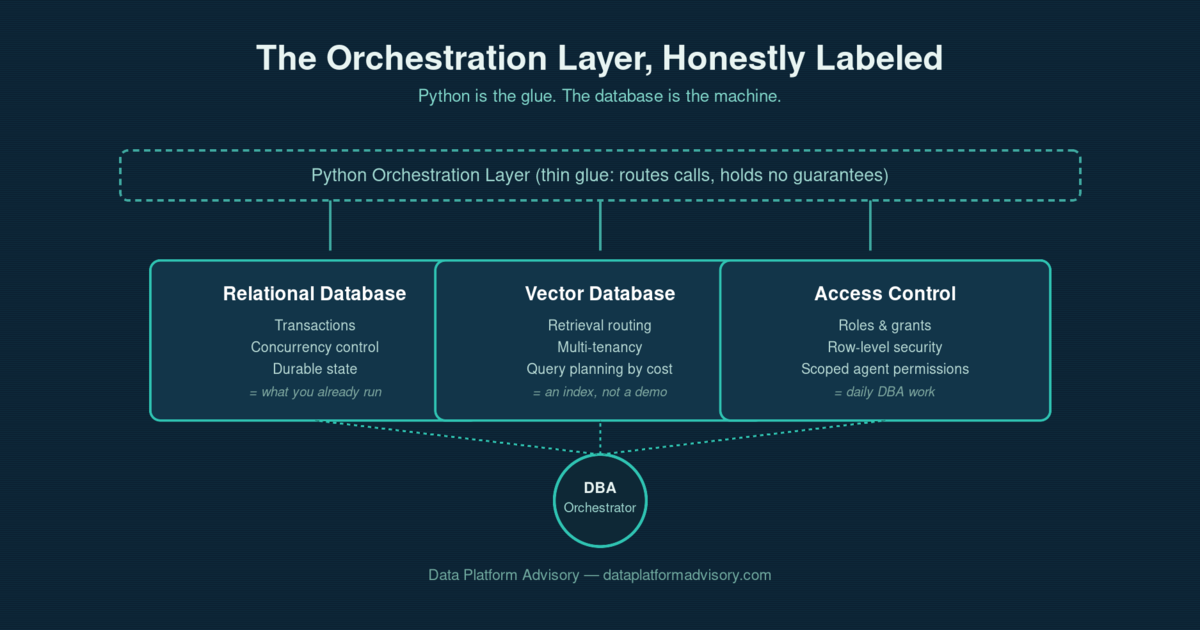
If you’re a DBA watching the AI hiring wave and wondering where you fit, here’s the direct answer: you’re not being replaced, you’re being asked to run a bigger system than the one you already run. Multi-agent AI systems are, underneath the marketing, state management, transaction persistence, and retrieval-index problems — the exact domain you’ve spent your career in. Python is the wiring. The database is the machine.
The misconception this post is correcting
Most agent frameworks are built by people who’ve never designed a schema under concurrent load. That’s not a jab — it’s a description of the hiring pipeline. Companies staffing “AI engineering” teams default to full-stack and Python developers, because Python is the language every agent framework — LangChain, LangGraph, CrewAI, AutoGen — ships its interface in. So the assumption becomes: agentic AI is a software engineering discipline, and databases are a backend detail someone else handles.
That assumption breaks the moment an agent system leaves the demo. A demo runs one agent, one user, one session, no concurrent load, no failure recovery, no audit trail. Production runs many agents, many sessions, retries, partial failures, and multiple writers touching shared state at the same time. Every one of those requirements has a name, and the name is “database problem.” Transaction persistence, concurrent access management, retrieval consistency, access control across tenants — none of it is Python’s job. Python calls the functions. It doesn’t own the guarantees.
Why the app-layer view falls apart under real load
Watch what actually happens when a multi-agent system scales past a demo. An agent needs to remember what it did three turns ago — that’s session state, and state that doesn’t survive a restart is a data durability problem, not a prompting problem. Two agents need to read and write a shared plan without stepping on each other — that’s concurrency control, the same problem two bank tellers hitting the same account balance have solved for fifty years with row locks and isolation levels. An agent needs to route a query to the right knowledge source out of several — that’s a routing and indexing problem, the same shape as a query planner choosing an index.
Vector databases make this concrete. Raw FAISS — the library most tutorials reach for first — has no API endpoints, no concurrent access management, no multi-tenancy, and no access control built in. It’s an index, not a database. The moment more than one agent needs to query it safely at the same time, or different agents need scoped access to different slices of the corpus, someone has to build the database layer FAISS doesn’t have: connection handling, isolation, permissions (StarTeck Manchester, “Vector Databases in 2026”). Teams that reach for ChromaDB, Qdrant, or Weaviate instead of raw FAISS in production are making exactly the decision a DBA would make: don’t build a database from scratch when correctness matters. Agentic RAG systems increasingly route queries between multiple retrieval strategies — semantic search, keyword match, hybrid — based on confidence scores, with agents passing work to each other the way a query optimizer chooses between an index scan and a table scan based on cost (Towards Data Science, “Multi-Agent SQL Assistant”).
You Already Know This
That’s the thesis of this series, and it’s worth naming outright: the skills agentic AI needs aren’t new. They’re the ones you already have, wearing unfamiliar names.
- Session memory that survives a restart is durable state — the same problem a database solves every time a server reboots mid-transaction.
- Two agents editing shared plan data is concurrency control — locking, isolation levels, optimistic version checks. Nothing here that MVCC didn’t already solve.
- Routing a query to the right retrieval source is query planning — picking the cheapest correct path to an answer based on cost and selectivity.
- Deciding which agent can read or write which data is access control — grants, roles, row-level security, the stuff you enforce daily and most application developers have never had to think about.
Each of the next two posts in this series works through one of these translations in detail: Pydantic’s structured validation as relational schema constraints in disguise, and LangGraph’s checkpointing as a write-ahead log wearing a new label. This post is the thesis. The next two are the proof. For a concrete look at what happens when agent state isn’t given a durable home in the first place, see Why Your AI Agents Keep Crashing — the same failure mode, viewed from the state-durability side rather than the retrieval side.
The analogy
An agent framework without a database architect designing its state layer is a query optimizer with no statistics — it will run, it will even return answers, and it has no idea whether the path it picked is fast, safe, or correct. It’s making decisions blind. A DBA sitting on that architecture isn’t a nice-to-have; they’re the missing statistics table.
Practical guidance
If you’re a DBA looking at the agentic AI wave and wondering where to plant a flag:
- Don’t learn Python to become a “real” AI engineer. Learn enough Python to read what an agent framework is doing to your data, then fix the data layer underneath it — that’s the leverage move.
- Ask, for any agent system you’re brought in on, three questions: where does state live when a process dies, what happens when two agents write at once, and who’s allowed to read what. If nobody can answer cleanly, that’s your opening.
- Treat vector databases as databases, not as a separate AI-only category. Concurrency, indexing strategy, and access control apply the same way they do to any other index.
- Push back on the framing that Python developers own “the AI layer” and DBAs own “the storage layer.” In a system that has to survive production, those are the same layer.
Key takeaways
- Multi-agent AI systems are state management, transaction persistence, and retrieval-index problems wearing new terminology — not a distinct engineering discipline.
- Python is the orchestration glue connecting agents to databases. It is not the architecture itself.
- Raw vector index libraries like FAISS lack the database fundamentals — concurrency control, multi-tenancy, access control — that production multi-agent systems require.
- Agentic RAG routing between retrieval strategies is functionally query planning: choosing the cheapest correct path based on cost.
- This is post one of three in “You Already Know This” — Pydantic-as-schema-constraints and LangGraph-checkpointer-as-WAL are next.
If your team is staffing an “AI engineering” effort and hasn’t put a database architect on it, that’s the gap. Get in touch or see how we approach it on our services page.
Ivan Lima is a data engineer specializing in database modernization for AI systems. Get in touch if your database needs to be ready for what’s next.