When Automated Rollback Reverts Your Code but Not Your Schema
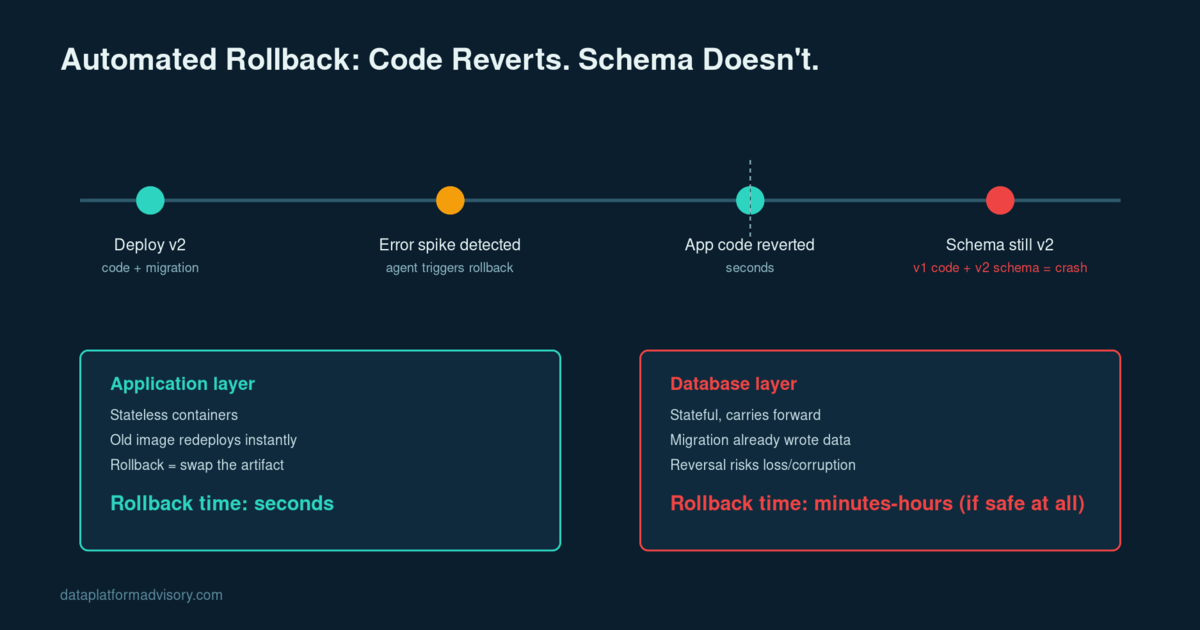
An automated rollback that reverts your application code in under a minute can leave your database schema stuck on the version that code no longer understands — and increasingly, it’s an AI agent making that call alone, without knowing the two don’t move at the same speed. The result isn’t a failed deploy that quietly resolves itself. It’s a second, often worse outage layered on top of the first one.
What’s happening
Autonomous and semi-autonomous CI/CD agents are now commonly given rollback authority: they watch error rates and health checks, decide a deploy is bad, and revert it without waiting for a human to confirm. This can cut mean time to recovery by 50-80% compared to manual intervention (Particle41, 2026), which is exactly why teams have handed agents this authority so readily. The problem is that “rollback” means something different at each layer of the stack, and most agents treat it as one action instead of two.
Application code is stateless. Rolling back a bad deploy usually just means redeploying the previous container image — the old version replaces the new one, cleanly, in seconds. A database is not stateless. If the deploy included a schema migration, that migration has already run: columns were added, data was backfilled, constraints were applied. “Rolling back” the database means reversing changes against data that has already been written in the new shape, and that is neither instant nor always safe (DoHost, 2026).
Real incidents already show the pattern. In March 2026, a team rolled back a payment service to fix a bug — the application code reverted cleanly, but the database schema stayed on the newer version. The mismatch crashed roughly 200 pods and produced a 98-minute outage, worse than the original bug. In April 2026, an AWS-hosted service suffered a similar failure when an AI-assisted deployment made simultaneous changes to load balancing and connection pooling; when the automated rollback ran those reversions sequentially instead of atomically, it made the outage worse rather than resolving it. Separately, a single DROP COLUMN migration has been documented triggering a cascading failure across five dependent services and a 22-minute outage on its own, with no rollback involved at all — just the forward migration outrunning the services that depended on the old shape.
Who this affects
This lands squarely on whoever owns the rollback decision path: platform and SRE teams that configure auto-remediation rules, database and data engineering leads who own migration tooling, and increasingly, whoever is responsible for what an AI ops agent is allowed to do unsupervised. If your organization has given an agent authority to trigger rollbacks based on error-rate or health-check thresholds, this is your problem specifically, not a general industry concern. It also affects application engineers who assume “the pipeline rolled it back” means the system is now consistent — it may not be.
Security and compliance teams have a secondary stake here too: a rollback that leaves a schema in an intermediate state is also a state that hasn’t been reviewed or audited, which matters for any environment where schema changes require sign-off.
When this becomes urgent
This isn’t a future risk — it’s already producing real outages, as the March and April 2026 incidents show. What’s changing the urgency curve is the rate at which rollback authority is shifting from humans to agents. As long as a person decided whether to roll back, there was a natural check: an engineer who’d shipped enough migrations knew, instinctively, that “revert the code” and “revert the database” were different asks with different risk profiles. That instinct doesn’t transfer to an agent unless someone explicitly encodes it.
Over the next 12-18 months, expect two converging trends to make this worse before it gets better: more teams giving agents rollback authority to hit aggressive MTTR targets, and more schema-migration tooling shipping AI-assisted migration generation without equally mature AI-assisted rollback safety (Augment Code, 2026). The tooling gap between “generate a migration” and “safely undo a migration under production load” is wider than most teams assume, and it’s not closing as fast as agent adoption is growing. This compounds the review-gap problem already documented when multiple AI agents propose schema changes in parallel — an agent that can’t see the full picture when merging is even less equipped to safely unwind it.
How it plays out technically
The failure mode is consistent across the incidents above. A deploy ships application code plus a database migration together, as a single logical unit, but they execute through fundamentally different mechanisms: the code deploy is a container swap, the migration is a DDL or DML operation against live data. When something goes wrong — an error spike, a failed health check, a bad metric — a rollback trigger fires. If that trigger only knows how to revert the deployment artifact (the common case, because that’s the fast, safe, well-understood half of the operation), the application reverts to code that expects the old schema while the database is still running the new one.
What actually breaks depends on the type of change. A renamed or dropped column causes immediate query failures — the old code references a column name the schema no longer has. A new NOT NULL constraint added during the forward migration can reject writes from the reverted code if that code doesn’t know to populate the new field. A changed data type can cause silent truncation or type-coercion errors rather than a clean failure, which is worse, because it doesn’t trip the health check that would trigger a second, corrective rollback.
Multi-service architectures amplify this. If five services share a database and only one was part of the failed deploy, a schema rollback attempt to “fix” that one service can break the other four that had already adapted to the new schema — this is effectively what happened in the documented DROP COLUMN cascading-failure case. There is often no rollback action that is simultaneously safe for every consumer of a shared schema.
Sequential rollback execution compounds the risk further, as the April 2026 AWS incident illustrates: reverting interdependent changes one at a time, rather than as a coordinated unit, can leave the system in an intermediate state that’s worse than either the fully-forward or fully-reverted state.
Actions to take now
-
Audit what your rollback automation actually reverts. For every service with automated rollback, check whether the trigger covers application code only, or code plus schema. Most default configurations cover only the former — that gap is your exposure.
-
Separate the rollback decision from the rollback mechanism for schema changes. This mirrors the same principle behind a schema-change approval queue for AI agents — apply it symmetrically to reversals, not just forward changes. Configure agents to detect and alert on a schema-related failure, but require explicit human approval before executing a schema reversal, even if code rollback stays fully automated. This is the single highest-leverage change most teams can make this week.
-
Adopt the expand-contract pattern for any migration that ships alongside code an agent might auto-rollback. Add new columns/tables as nullable and backward-compatible first, deploy code that can read both old and new shapes, backfill, and only remove the old shape in a separate, later, deliberate step. This makes “roll back the code” safe on its own, because the schema never stops being backward-compatible mid-flight.
-
Treat schema migrations as forward-only in your rollback tooling. Rather than attempting to auto-generate a “down” migration, write a compensating forward migration when something needs to be undone, and test that compensating path in staging before it’s ever needed in production.
-
For multi-service shared schemas, map dependency graphs before granting any agent rollback authority. If more than one service reads or writes the same tables, a single-service rollback plan is incomplete by definition — the agent (or the human writing its rules) needs to know every consumer before deciding rollback is safe.
-
Require atomic, not sequential, execution for coordinated infrastructure and schema changes. If a deploy touches multiple interdependent systems, the rollback plan needs to revert them as one transaction-like unit or hold everything at the last known-consistent checkpoint — not walk backward through changes one at a time.
-
Add a schema-version compatibility check as a pre-condition for any automated code rollback. Before an agent reverts application code, have it query the current schema version and refuse to proceed automatically if that version doesn’t match what the target code expects — fail safe into a human escalation instead of executing a mismatched rollback.
-
Run rollback drills, not just deploy drills. Most teams test that a deploy works. Fewer test that a rollback — specifically a schema-adjacent rollback — works cleanly under realistic data volumes. Schedule this quarterly for any service with schema-coupled auto-rollback enabled.
Key takeaways
- Automated rollback pipelines routinely revert application code in seconds but cannot revert database schema state on the same timescale, because code is stateless and databases carry state forward.
- Real 2026 incidents — a 98-minute payment-service outage from a code/schema mismatch and an AWS incident worsened by sequential rollback of interdependent changes — show this is an active, not hypothetical, risk.
- AI agents given autonomous rollback authority don’t inherently know that “revert the code” and “revert the schema” are different operations with different risk profiles, unless that distinction is explicitly engineered into their rules.
- The expand-contract migration pattern, forward-only compensating migrations, and a hard human-approval gate on schema reversal are the most effective mitigations available today.
- The gap between AI-assisted migration generation and AI-assisted migration rollback safety is currently wide and growing as more teams adopt agentic rollback for MTTR gains.
If your rollback automation has never been tested against a real schema-coupled failure, the first time it runs in production shouldn’t be during an actual incident. Get in touch if you want a second set of eyes on your migration and rollback pipeline before it’s tested for you.
Ivan Lima is a data engineer specializing in database modernization for AI systems. Get in touch if your database needs to be ready for what’s next.