The Hidden Risk of Parallel AI Agents Merging DB Schemas
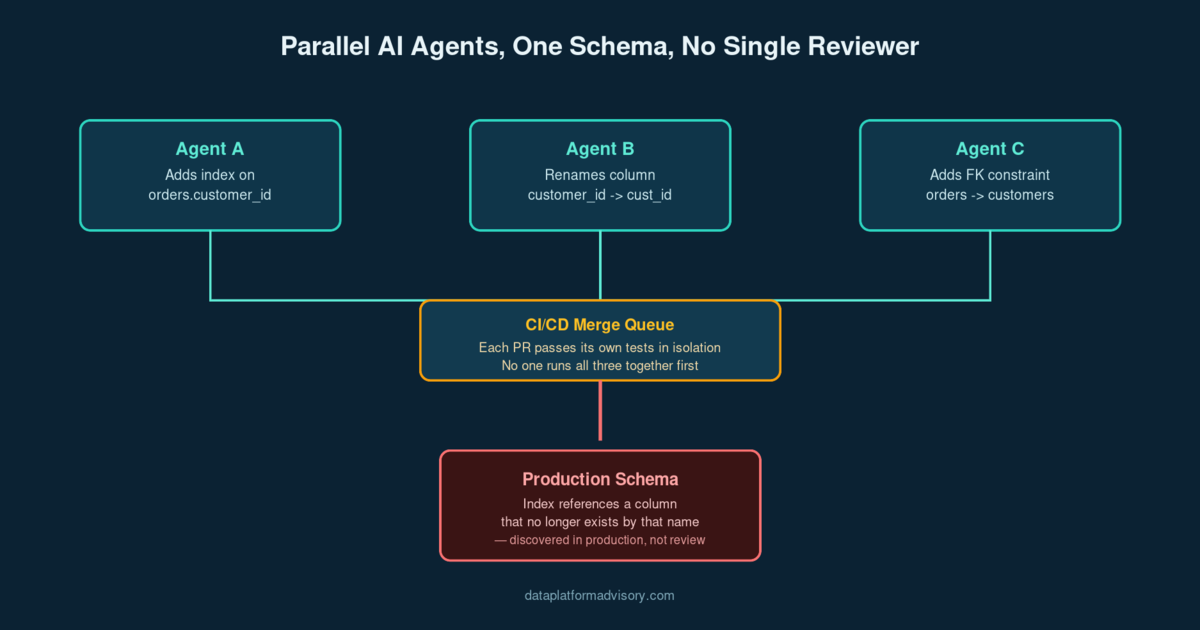
Three AI coding agents can each open a passing, well-tested pull request against the same database schema on the same afternoon — and none of them will see what the other two changed. Each PR looks clean in isolation: tests pass, the diff is small, the agent’s own review comment says “safe, backward compatible.” The problem only shows up after all three merge, when a renamed column breaks an index another agent just added and a foreign key a third agent just created. This is not a hypothetical. It’s the predictable result of running multiple autonomous coding agents against a shared schema through a CI/CD pipeline that was built to gate one human’s changes at a time, not to reconcile three independent actors’ assumptions about what the schema currently looks like.
What’s happening
Multi-agent coding setups are no longer a novelty. Teams now routinely run several autonomous or semi-autonomous coding agents in parallel — often using isolated git worktrees so each agent gets its own working directory and index while sharing a single object database — specifically to get more throughput out of AI-assisted development (MindStudio, 2026). The pattern works well for application code, where merge conflicts are visible and mechanical. It works much worse for database schemas, where the “conflict” isn’t always a textual diff collision — it’s a semantic one. Two migrations can touch completely different files, pass their own tests, and still be mutually incompatible the moment they land on the same schema.
Database-specific CI/CD tooling has adapted quickly on the automation side. Schema-versioning tools like Liquibase now integrate directly with GitHub Actions to let AI-authored changes deploy through the same pipeline as everything else, and dedicated migration agents can map real dependency graphs and generate rollback scripts rather than just raw DDL (Augment Code, 2026). What hasn’t kept pace is the review layer that sits above individual pull requests — the thing that used to be a senior DBA mentally holding “here’s everything in flight against this schema right now” is not a job any current pipeline design assigns to anyone, human or agent.
Layered on top of that coordination gap is a second, more adversarial one. Early 2026 saw the CI/CD attack surface itself become a headline target: the LiteLLM supply-chain breach compromised a widely used open-source AI gateway through its build pipeline’s security scanner, staying live for roughly 20 days and potentially exposing 434,000 CI/CD pipelines across more than 2,500 organizations (CloudSEK, 2026). Separately, third-party involvement in breaches doubled year over year — from 15% to 30% of all breaches — the largest single-year shift the Verizon Data Breach Investigations Report has recorded (via Deepstrike, 2026). A pipeline that already can’t reconcile three well-intentioned agents’ schema changes is not a pipeline ready to catch one badly-intentioned one riding along in a plausible-looking migration diff.
Who this affects
The people most exposed are the ones who assumed the CI/CD pipeline was still doing what it did when one human team wrote all the code: database administrators and data engineering leads, whose mental model of “what’s currently true about this schema” no longer matches reality once three or four agents are proposing changes in parallel; engineering managers who greenlit multi-agent coding tools for velocity without updating the review process underneath them; and platform/DevOps teams responsible for the merge queue and deployment gates, who now have to design for semantic conflicts between passing PRs, not just textual ones. Security and compliance teams inherit this too — an unreviewed aggregate of independently-approved schema changes is exactly the kind of blind spot that shows up in an incident postmortem as “how did nobody catch this” — the same class of gap explored in AI Agent Guardrails for Databases.
Smaller teams running one or two agents against a database are lower risk in absolute terms, but the risk scales directly with the number of concurrent agents, which is also the number every vendor is currently pushing customers to increase. The practical ceiling teams report before merge conflicts, rate limits, and review bottlenecks start eating the productivity gains is somewhere around five to seven concurrent agents on a single codebase (DoltHub, 2025) — which means teams are being pushed toward exactly the concurrency level where this problem becomes unavoidable, not toward the level where it’s still a curiosity.
When this becomes a real problem
This isn’t a three-to-ten-year horizon risk — it’s already happening in any organization that has adopted parallel AI coding agents against a shared database this year. Individual developer adoption of AI in DevOps workflows crossed 90% in early 2026, though only around 13% of teams have deployed agents across the full delivery lifecycle so far (Zylos Research, 2026) — meaning most teams are still in the early, lower-concurrency phase where this risk is latent rather than realized. It compounds the capacity mismatch already covered in The Database Was Provisioned for Humans. Agents Broke the Model — the same agents straining infrastructure sized for human traffic are the ones now proposing unreviewed-in-aggregate schema changes. The honest timeline is: low risk today if you’re running one agent at a time with a human still reviewing every migration; meaningfully elevated risk within the next 6-18 months as teams scale up concurrent agent usage to chase the productivity numbers vendors are advertising, unless the review architecture changes first. The CI/CD attack-surface risk is not a future problem at all — it’s already producing real, dated incidents, with the LiteLLM breach as the most visible 2026 example so far.
How it actually plays out
The failure mode is rarely a single catastrophic migration. It’s a set of individually reasonable changes that don’t compose. A concrete version of the scenario:
- Agent A is asked to improve query performance on the
orderstable and adds an index oncustomer_id. Its own test suite passes — the index doesn’t break anything it touches. - Agent B, working a separate ticket to standardize naming conventions, renames
customer_idtocust_idacross theordersandcustomerstables, updates the ORM models it can see, and its tests pass too — its scope didn’t include the index Agent A hadn’t merged yet. - Agent C is adding referential integrity and creates a foreign key from
orders.customer_idtocustomers.id, generated from the schema as it existed when Agent C started its task — before either of the other two PRs landed.
Each PR is reviewed and approved independently — by a human skimming a small, plausible diff, or by another agent doing single-PR review focused on security, performance, or style rather than cross-PR schema state (Termdock, 2026). The CI/CD merge queue runs each PR’s tests against the schema state at merge time, but nothing in a typical pipeline re-derives “what does the schema look like with all three of today’s approved-but-not-yet-merged changes applied together” before allowing the third one to merge. The result: Agent C’s foreign key references a column name that no longer exists by that name, or Agent A’s index silently becomes dead weight pointing at a renamed column. Depending on merge order and how strict the migration tooling is, this surfaces as anything from a failed deploy (best case, caught in CI) to a silent, expensive-to-diagnose production issue (worst case, caught by a customer).
The adversarial version of this same gap is what makes it more than an efficiency problem. A pull request’s diff is, structurally, untrusted text landing in an AI reviewer’s context window — and prompt injection embedded in a diff, a commit message, or even a code comment has no fully reliable fix today (via search synthesis, CI/CD agent review risk, 2026). A pipeline already struggling to reconcile three legitimate agents’ schema assumptions is not well positioned to notice a fourth, malicious-looking-plausible migration riding through the same review gap.
Actions to take now
- Inventory your current agent concurrency. Before anything else, find out how many AI coding agents can propose changes against your production schema in parallel today, and whether any of them are scoped to touch schema-affecting files versus application code only. Most teams haven’t actually counted.
- Designate a migration owner per schema domain, not per PR. Assign one agent or one human as the sole approver for changes to a given set of tables during any given window, so at least one party always has the full “what’s currently in flight” picture — a pattern already recommended for multi-tenant SaaS schema work (Kinde, 2026).
- Add a pre-merge composite check. Before allowing a schema-affecting PR to merge, run its migration against a database state that already includes every other approved-but-unmerged schema PR, not just the last-merged main branch. This catches Agent-A/B/C-style conflicts before they ever reach production, and it’s a straightforward addition to most CI pipelines using a scratch database spun up per merge-queue run.
- Match agent autonomy to schema-change risk, not to task type. Apply the tiered-autonomy pattern already emerging in CI/CD governance: low-risk changes (adding a non-breaking index) can proceed with lighter review; anything that renames, drops, or changes the type of a column that other in-flight PRs might reference should require human-in-the-loop approval and enhanced logging, regardless of how confident the agent’s own test suite is (arXiv, “From Assistance to Agency,” 2026).
- Treat AI-authored migration diffs as untrusted input to your review agents, not just your database. If you’re using an AI reviewer on schema PRs, don’t let it execute instructions found inside the diff, commit message, or inline comments — review-agent prompts should explicitly separate “code to evaluate” from “instructions to follow.”
- Run a tabletop exercise with your actual pipeline, not a hypothetical one: pick two or three real recent schema changes, replay them as if proposed simultaneously by separate agents, and see whether your current CI catches the interaction. If it doesn’t, you’ve found your gap before a customer does.
- Cap concurrent schema-affecting agents below your application-code concurrency ceiling. There’s no reason your database schema needs the same agent parallelism as your UI code — deliberately throttle how many agents can simultaneously propose DDL changes until your composite-check tooling (step 3) is in place.
- Revisit this quarterly as agent vendors push higher concurrency. The 5-7 agent practical ceiling reported today will move. Your schema review architecture needs to be re-evaluated every time your team’s actual concurrent-agent usage increases, not once and forgotten.
Key takeaways
- Multiple AI coding agents can each open a passing, individually-reviewed PR against the same database schema and still produce an incompatible result once all three merge — because CI pipelines check each PR against the last-merged state, not against every other approved-but-unmerged change.
- This is a present-day risk, not a future one, for any team running parallel AI coding agents against a shared schema today; it scales with agent concurrency, which is exactly the metric vendors are pushing teams to increase.
- The 2026 CI/CD attack surface (the LiteLLM breach exposing an estimated 434,000 pipelines) makes this more than an efficiency problem — a pipeline that can’t reconcile legitimate concurrent changes is also poorly positioned to catch an adversarial one hiding in a plausible diff.
- The fix isn’t slowing down agent adoption — it’s adding a composite pre-merge check that evaluates all in-flight schema changes together, and matching agent autonomy to the actual risk of the specific change, not the task category.
- A single designated migration owner per schema domain remains the simplest mitigation available today, and it costs nothing to implement this week.
Data Platform Advisory helps teams design the review and CI/CD architecture their database actually needs before multiple AI agents start proposing changes to it — not after the first incompatible migration reaches production. See how we approach this.
Ivan Lima is a data engineer specializing in database modernization for AI systems. Get in touch if your database needs to be ready for what’s next.