LangGraph is a Stateful Database Problem
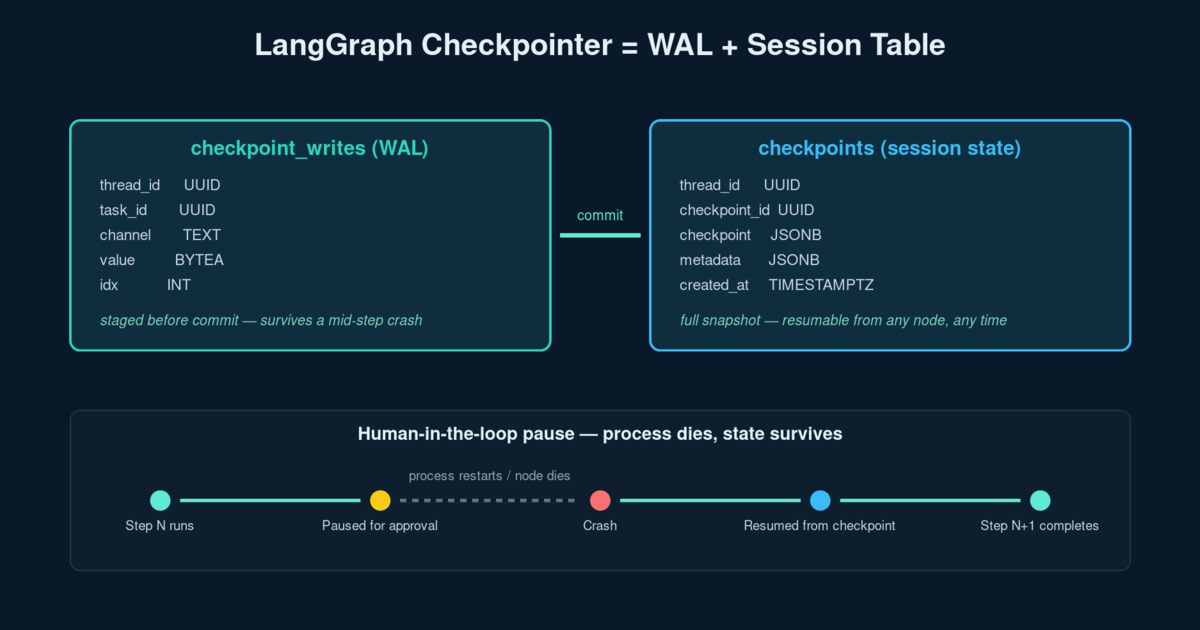
A LangGraph agent that “loses its place” mid-workflow isn’t suffering from a bad prompt or a flaky model call — it’s suffering from a missing checkpointer, which is just a missing persistence layer wearing a new name. The moment your agent needs to pause for human approval, resume after a crash, or replay from a known-good point, you’ve left the world of stateless scripts and entered the world every DBA already lives in: durable, recoverable, concurrent state. You already know this. You’ve been building it for years, just not for a graph of LLM calls.
This closes out the “You Already Know This” series. Post one argued that agentic AI is state management and transaction persistence with a Python wrapper. Post two showed that Pydantic validation is table constraints in a different syntax. This one takes the claim to its most literal conclusion: LangGraph’s flagship reliability feature is, structurally, a write-ahead log.
Why does LangGraph need a checkpointer at all?
Because a graph with cycles can fail, pause, or get killed mid-execution, and without a durable record of where it was, the only recovery option is starting over from node one — discarding every LLM call, tool result, and human decision made along the way.
This is the real shift from LangChain to LangGraph. A linear chain is a script: input goes in one end, output comes out the other, and if it crashes halfway, you just run it again — nothing expensive was at stake. A graph is different. Graphs have loops, conditional branches, and — critically — points where the workflow has to stop and wait for a human to approve, reject, or edit something before continuing. You cannot “just rerun” a workflow that’s sitting there waiting for a human-in-the-loop approval. The state at that pause point has to survive as long as the human takes to respond, whether that’s ten seconds or three days.
Why the application-layer fix falls apart
The instinctive move for a team without a database background is to hold the graph’s current state in memory — a dictionary keyed by thread ID, maybe backed by a cache — and call it done. This is the same mistake covered in the first post of the “Database-First Agent Architecture” series: memory without durability guarantees is not memory, it’s a variable that happens to survive until the process doesn’t.
It fails in the same three predictable ways. The process restarts and the paused workflow vanishes, taking the human’s pending approval with it. Two workers handling the same thread ID both read and write the cache with no isolation, and one silently overwrites the other’s progress. And there’s no audit trail — when a workflow produces a wrong result three steps in, there’s no record of the intermediate state to inspect, just whatever’s left in memory at the moment someone thinks to look.
None of this is a LangGraph problem specifically. It’s what happens any time someone builds a stateful system without a data store designed to be stateful.
The database-first explanation: checkpointers are WAL plus a session table
LangGraph’s answer to this is the checkpointer, and the production-grade version of it — PostgresSaver / AsyncPostgresSaver — is not a novel invention. It’s two relational patterns any DBA would recognize immediately.
The first table, checkpoints, is a session state table. Each row is a full snapshot of the graph’s state at a given step, keyed by a thread_id that groups every snapshot belonging to one conversation or run, with the state itself stored as JSONB and larger values offloaded to a companion checkpoint_blobs table when they’re too big for inline storage (LangChain checkpoint reference).
The second table, checkpoint_writes, is the more interesting one, because it’s functionally a write-ahead log. Before a full checkpoint row commits to the checkpoints table, each individual channel write for that step is staged in checkpoint_writes first. That staging step exists for exactly the reason WAL exists in a relational database: without it, the only safe response to a failure mid-step is to re-run the entire node from scratch, which for an agent means re-issuing LLM calls, re-triggering tool side effects, and potentially charging the same API call twice (lordpatil, “Internals of LangGraph Postgres Checkpointer”). Stage the write, confirm it landed, then commit the checkpoint — the same durability discipline that’s kept relational databases from losing transactions during a crash since before most of us started our careers.
This is the same durable-state problem as post one’s Agent State Ledger, just framed inside a different framework. Where the Agent State Ledger uses a version column for optimistic concurrency on custom agent state, LangGraph’s checkpointer uses thread_id plus a checkpoint sequence to achieve the same goal — a database-backed guarantee that state survives the process and that concurrent writers don’t silently clobber each other. If you’ve already read why your AI agents keep crashing, this is the same architecture wearing LangGraph’s naming conventions.
The evidence: what a real setup looks like
from langgraph.checkpoint.postgres import PostgresSaver
from psycopg_pool import ConnectionPool

pool = ConnectionPool(
    conninfo="postgresql://user:pass@host:5432/agents",
    max_size=10,   # a pool of 10 serving many concurrent invocations
                   # is the standard production pattern, not a guess
)

checkpointer = PostgresSaver(pool)
checkpointer.setup()  # creates checkpoints, checkpoint_blobs, checkpoint_writes

graph = builder.compile(checkpointer=checkpointer)

config = {"configurable": {"thread_id": "case-4471"}}
graph.invoke({"messages": [("user", "Approve refund for case 4471?")]}, config)

# Process dies here. Days later, on a different node:
graph.invoke(None, config)  # resumes from the last committed checkpoint
Connection pooling matters here for the same reason it matters in any high-concurrency Postgres application: a small pool serving many concurrent graph invocations via async multiplexing is the documented production pattern for AsyncPostgresSaver, not an incidental detail (ActiveWizards, LangGraph persistence and the checkpointer decision). Treat it like any other connection-starved production database — because that’s what it is.
One operational note worth flagging as a DBA, not an AI engineer: checkpoint tables grow fast, because every superstep writes a new row instead of updating in place. Left unmanaged, this produces exactly the kind of write-amplification and table bloat you’d expect from an insert-only audit table with no retention policy — a problem several teams have already hit in production Postgres-backed LangGraph deployments (azguards, checkpoint bloat and write-amplification). That’s not a LangGraph bug. That’s a missing retention and vacuum strategy, and it’s the exact kind of problem a DBA is already equipped to catch before it takes down a production database.
The analogy
A LangGraph checkpointer is a write-ahead log and a session state table wearing an AI framework’s naming conventions. Strip away the thread_id and superstep vocabulary and what’s left is the same pattern relational databases have used for decades: stage the write, confirm durability, commit the snapshot, and keep enough history to resume or roll back on demand. The framework is new. The engineering discipline underneath it is not.
Practical guidance
Use PostgresSaver or AsyncPostgresSaver for anything beyond local prototyping — SqliteSaver is fine for a single process, but multi-process or multi-node deployments need Postgres or a comparable durable backend. Size your connection pool for concurrent invocations, not concurrent users — one user can trigger many graph steps in parallel. Build a retention policy for the checkpoints and checkpoint_writes tables before you need one; insert-only state tables bloat exactly like insert-only audit logs, because that’s what they are. And treat thread_id design the same way you’d treat any partition key — get the grain wrong (too coarse, too fine) and you’ll feel it in both query performance and correctness.
Key takeaways
- LangGraph’s checkpointer is a write-ahead log (
checkpoint_writes) plus a session state table (checkpoints), not a new architectural concept. - The problem it solves — durable state across process restarts and human-in-the-loop pauses — is the same durable-state problem covered by the Agent State Ledger pattern, just implemented inside a specific framework.
SqliteSaveris fine for single-process prototypes; production, multi-node deployments needPostgresSaver/AsyncPostgresSaverwith a properly sized connection pool.- Checkpoint tables are insert-only and grow fast — plan retention and vacuum strategy from day one, not after the table bloats.
- If you can design a WAL-backed transaction system or a session state table, you already have the skill LangGraph’s persistence layer depends on.
This closes the “You Already Know This” series: agentic RAG is retrieval and transaction persistence, Pydantic is table constraints, and LangGraph’s checkpointer is a write-ahead log. Three frameworks, one underlying discipline — the one DBAs have been practicing the entire time.
If your team is building agent workflows on LangGraph, CrewAI, or a custom orchestration layer and nobody’s asked what happens to state when a node fails mid-execution, that gap is worth closing before it costs you a production incident. Get in touch if your database needs to be ready for what’s next.
Ivan Lima is a data engineer specializing in database modernization for AI systems. Get in touch if your database needs to be ready for what’s next.