The Database Modernization Checklist Every CTO Should Run Before Scaling AI
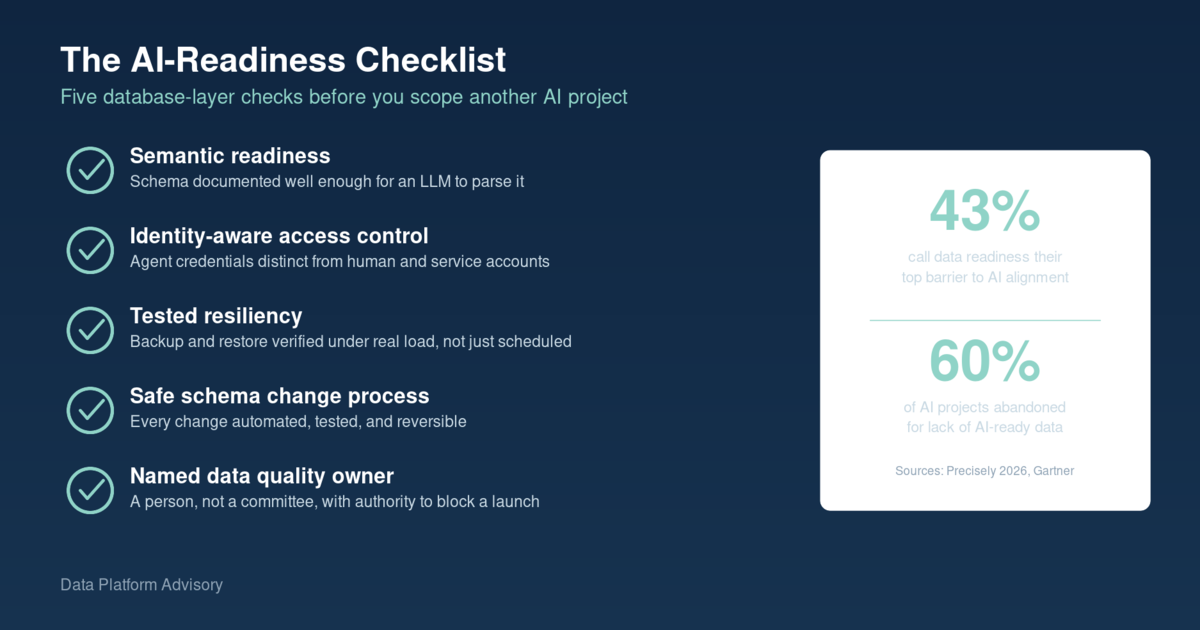
Before approving another AI initiative, run this checklist against your actual database layer: schema documentation an LLM can parse, row-level access control tied to real identities (including AI agents), tested backup/restore under load, a rollback path for every schema change, and a named owner for data quality. If you can’t check all five today, that’s the modernization work — not the AI project — that belongs at the top of your roadmap.
Why this checklist exists
Most AI initiatives don’t fail because the model is wrong. They fail because the data underneath it was never built to support what’s being asked of it now. A 2026 Precisely survey of 500+ data and analytics leaders found 87% say they have the infrastructure needed for AI — and in the same breath, 43% cite data readiness as their single biggest obstacle to aligning AI with business goals. That’s not a contradiction. It’s two different questions. Having servers, storage, and a cloud account is not the same as having a database an AI system can safely read from, write to, and be governed against.
The cost of skipping this step is well documented. Gartner has said 60% of AI projects will be abandoned through 2026 for lack of AI-ready data, and separately found 85% of failed AI projects trace back to poor data quality, with only 12% of organizations judging their own data quality sufficient for AI use. RAND Corporation’s analysis of 2,400+ enterprise AI initiatives puts overall AI project failure at over 80%. None of that is a model problem. It’s a foundation problem, and the foundation is the database. We’ve looked at why the gap between AI confidence and AI readiness keeps widening before — this checklist is the practical follow-up.
Key takeaways
- 87% of leaders claim AI-ready infrastructure; 43% name data readiness as their top blocker — the gap is real and it’s yours to close before the next AI project starts.
- Gartner projects 60% of AI projects will be abandoned through 2026 for lack of AI-ready data; 85% of failures trace to poor data quality.
- Five checklist items matter most: semantic documentation, identity-aware access control, tested resiliency, safe schema change process, and a named data quality owner.
- Governance isn’t a compliance afterthought — organizations with formal governance programs report 71% high data trust, versus 50% without one.
- Run this checklist before scoping the AI project, not after it stalls in production.
The five things to check before you scope another AI project
1. Can an LLM actually understand your schema?
Column names like cust_flg_3 and undocumented foreign keys made sense to the engineer who wrote them in 2014. They mean nothing to an LLM doing text-to-SQL or a retrieval agent deciding which table holds the answer. Semantic readiness — data dictionaries, business-context descriptions on tables and columns, and where relevant, embeddings for semantic search — is what turns a database from something only your senior DBA can navigate into something an AI system can reason about safely. If nobody can point to a current data dictionary for your production schema, that’s the first gap to close.
2. Does access control know the difference between a person and an agent?
Most access models were built for humans logging in with a username and password. AI agents now query databases directly, often through service accounts or shared credentials that were never designed to be attributed to a specific automated actor. That’s a governance blind spot: if an agent’s query can’t be distinguished from a human’s in your audit log, you can’t answer “which agent touched this data and why” when it matters. Scoped, least-privilege, short-lived credentials issued specifically to agents — distinct from human IAM and from generic service accounts — are no longer optional once agents have direct database access. We’ve covered the mechanics of treating agent identity as its own governance problem in more depth.
3. Have you actually tested your backup and restore, under realistic load, recently?
Resiliency gets checked off on paper more than it gets checked in practice. A backup job that runs nightly isn’t the same as a restore that’s been tested against current data volumes and current recovery-time expectations. AI workloads raise the stakes here because a stale or incomplete restore doesn’t just cost downtime — it can silently feed a model or agent bad data long after the “recovery” is declared complete.
4. Does every schema change have a tested rollback path?
Manual, unreviewed schema changes are still the norm at most companies, and AI-assisted development is increasing the rate of proposed changes without necessarily increasing the rigor behind them. Before scaling AI-driven development against your database, confirm that schema changes go through automated testing and validation, and that every change has a real rollback path — not a hope that the next deploy fixes it.
5. Who owns data quality, by name?
Precisely’s research found organizations with an active data governance program report 71% high trust in their data, against 50% for those without one — and governance programs correlate directly with better AI outcomes, not just better compliance posture. But governance only works if someone owns it. If “data quality” is everyone’s job, it’s no one’s job. Name an owner, give them the authority to block a launch over a data quality gap, and revisit that ownership as AI use cases expand.
What to do with this checklist
Run it before you scope the next AI initiative, not after it stalls in a pilot that never reaches production. Precisely’s research shows the pattern clearly: the gap between “we have the infrastructure” (87%) and “our data is actually ready” (43% say it’s their top barrier) is exactly where AI budget goes to die. Closing that gap is database modernization work — schema documentation, identity-aware access control, tested resiliency, safe change management, and named ownership. None of it is glamorous. All of it is what separates the minority of AI projects that succeed from the majority that don’t.
If your team is scoping an AI initiative and isn’t sure the database underneath it can support it, that’s exactly the conversation worth having early. Get in touch — a short readiness review is a lot cheaper than a stalled AI project.
Ivan Lima is a data engineer specializing in database modernization for AI systems. Get in touch if your database needs to be ready for what’s next.