Your Database Is AI FinOps' Last Attribution Blind Spot
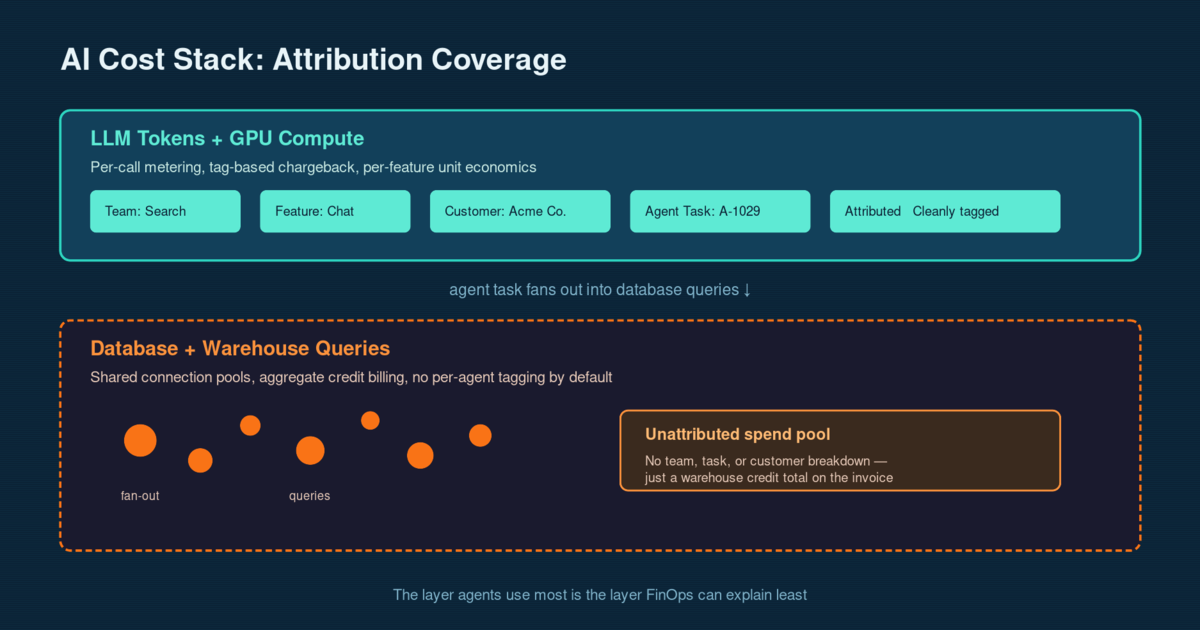
Most enterprises can now answer “which team’s AI spend is this?” for LLM tokens and GPU compute — tagging and per-call metering made that possible. Almost none can answer the same question for the database and warehouse queries those same agents generate underneath. The result is a growing gap in AI cost governance: the layer where agent activity is often most expensive is the layer finance can least explain, and that gap is starting to show up in budget reviews as a line item nobody can defend.
What’s actually happening
AI FinOps has matured fast on the parts of the stack that were built to be metered. Token usage per model call, per-GPU-hour billing, per-request inference cost — these are natively countable, and the tooling built around them (cost dashboards, tag-based chargeback, per-feature unit economics) has caught up over the past year. Finout’s 2026 review of AI cost visibility and current State of FinOps for AI reporting both point to the same trend: 98% of organizations now say AI cost management is a top priority, up sharply from a year earlier, and attribution — mapping every dollar to a team, product, or customer — is treated as the foundation everything else (showback, chargeback, budget alerts) is built on.
The database layer didn’t get the same upgrade. A single agent task routinely fans out into dozens of short, cheap-looking queries against a shared warehouse or managed database — and those queries land in the same connection pool, the same compute cluster, and often the same billing bucket as every other workload hitting that system. Snowflake’s own documentation on query attribution is candid about the limits here: attribution is based on a weighted average of resource consumption across queries sharing a warehouse, not a precise per-query charge, and without deliberate tagging discipline, an agent’s fan-out queries are invisible as a distinct cost center — they just look like general warehouse load. Analysis of AI agents running against Snowflake in 2026 puts it bluntly: analyst dashboards and AI agents emit fundamentally different query patterns, and per-credit warehouse pricing handles one well and the other badly, but the deeper problem is that without aggregation by agent, task, or session, the cost pattern doesn’t just get mispriced — it disappears from the report entirely.
This is a related but distinct problem from agent workloads simply costing more. Data platform cost blowouts from agent query patterns are visible once someone looks at the bill. Attribution failure is worse, because the bill looks normal in aggregate — it’s just unexplained. A warehouse invoice that’s 30% higher than last quarter with no team, feature, or customer able to account for the increase isn’t a cost problem finance can optimize; it’s a cost problem finance can’t even locate.
Who this affects
Data engineering and platform leads feel it first operationally — they’re the ones asked “why is the warehouse bill up” without a query-level answer, because most database observability was built to diagnose slow queries, not to allocate their cost. FinOps and cloud cost teams are affected next: they’ve built mature showback and chargeback processes for compute and SaaS spend, and the database is often the one line item that resists the same treatment, which undermines the credibility of the whole cost-allocation program when a stakeholder asks why one line is different from the rest.
CTOs and VPs of engineering carry the budget exposure — an unattributed cost center can’t be defended in a board review or forecasted for the next funding round of AI initiatives, and it’s the kind of gap that shows up as a surprise during an annual planning cycle rather than a manageable monthly trend. Finance and procurement teams evaluating vendor contracts are affected too: without attribution, they can’t negotiate reserved capacity or committed-use discounts against real per-team demand, because they don’t know which teams are actually driving the demand. And product teams building agent features are quietly affected as well — without cost-per-agent-task visibility, a genuinely expensive feature can ship and scale for months before anyone connects its adoption curve to the warehouse bill.
When this becomes a hard problem
This isn’t a future risk — it’s already the state of most database cost reporting in mid-2026, it’s just not yet painful for most organizations because agent-driven database load is still a minority of total query volume at many companies. That’s changing quickly. Coverage of agent workload growth against Snowflake-style consumption pricing describes 2026 as the year agent-driven query volume stopped being a rounding error against human-driven dashboard and reporting traffic at data-forward companies, and that shift compounds: more agents shipped, more autonomous task chains, more database calls per business outcome.
The realistic timeline: within the next two to four quarters, most mid-size-and-up companies running production AI agents against their own databases will have a warehouse or database cost attribution gap large enough to appear in a budget review, if it hasn’t already. Within twelve to eighteen months, expect this to show up as an explicit line item in FinOps tooling roadmaps and vendor feature lists — attribution for database and data-platform spend specifically, not just compute and model spend — the same way “FinOps for agentic AI” itself has already become its own tracked category in 2026 industry coverage. Organizations that build attribution discipline now are building it proactively; organizations that wait will build it reactively, during a budget crisis, with much less time to do it carefully.
How this actually plays out in a real environment
The mechanics are simple, and that’s exactly why they’re easy to miss. An agent orchestration framework (a multi-step agent chain, a retrieval pipeline, a multi-agent delegation flow) issues a burst of queries as part of a single logical task — a lookup, a permission check, a context-retrieval query, a write to a session or memory table, maybe a retry after a timeout. None of those queries individually look unusual to a database engine tuned to optimize for latency and throughput, not for cost provenance. They land in a shared connection pool alongside human-driven traffic and other agents’ traffic, and the database or warehouse’s cost accounting — built around aggregate compute-second or credit consumption — has no native concept of “this credit belongs to Agent X’s task Y on behalf of Customer Z.”
Multi-agent systems make this worse. Multi-hop delegation between agents already creates an identity problem — who is the database connection actually representing when Agent A delegates to Agent B, which delegates to Agent C? The same delegation chain that breaks clean access control also breaks clean cost attribution, because a query executed three hops into a delegation chain typically carries no metadata connecting it back to the original task, team, or customer that triggered it. Without deliberate propagation of a task ID or session tag through every hop, the cost of that query gets attributed to whatever service account or connection pool happened to execute it — usually a shared, generic one.
The workaround that exists today — query tagging — is a real and available lever, but it’s manual, easy to skip under deadline pressure, and unevenly supported across database engines. Best practices for query tagging in Snowflake recommend tagging every agent query with a task ID specifically because the platform won’t infer that context on its own — it has to be attached deliberately, at write time, by the application or orchestration layer issuing the query. Most agent frameworks weren’t built with that discipline baked in by default, which means attribution quality today depends entirely on whether the team that built the agent thought to add it.
Actions to take now
- Audit your current database and warehouse bill for attribution coverage today. Pull your last billing cycle and ask what percentage of compute or credits can be traced to a specific team, feature, or agent versus a generic shared pool. If you can’t answer that question in an afternoon, you already have the problem described here — this audit alone is usually the wake-up call.
- Start tagging agent-originated queries immediately, even imperfectly. Add a task ID, agent ID, or session ID to the query tag or comment field on every agent-issued query, propagated through the orchestration layer. Partial coverage started this quarter beats complete coverage planned for next year — attribution data compounds in value the longer it’s been collected.
- Isolate agentic workloads into dedicated warehouses or resource pools where your platform supports it. Even without perfect per-query attribution, workload-level isolation (a warehouse or compute pool dedicated to agent traffic, separate from human-driven dashboards and reporting) gets you coarse-grained attribution almost for free and makes the fan-out cost pattern visible in aggregate.
- Extend attribution metadata through delegation chains, not just at the entry point. If agents delegate to other agents, make sure the originating task or customer identifier is propagated at every hop — not just tagged on the first query — or you’ll have clean attribution for simple agent tasks and a black hole for complex ones, which are usually the expensive ones.
- Bring your FinOps or cost governance team into agent architecture reviews before launch, not after the bill arrives. The 2026 trend toward “FinOps for agentic AI” as its own discipline exists because cost governance needs a seat at the design table for agent systems the same way security already does — retrofitting attribution onto a live agent fleet is materially harder than designing it in.
- Set a budget owner and an escalation threshold for unattributed spend specifically, separate from your overall database cost alerts. An “unattributed spend” metric that’s allowed to grow quietly is exactly how this becomes a surprise budget review instead of a managed trend line.
- Evaluate database and warehouse vendors on attribution tooling, not just raw price, in your next contract cycle. As this becomes a tracked capability across the market, vendors will differentiate on it — factor that into build-vs-buy and renewal decisions now rather than discovering the gap mid-contract.
Key takeaways
- AI FinOps has matured for LLM and GPU spend but not for database and warehouse spend generated by agent workloads, creating a growing attribution blind spot.
- The problem isn’t that agent database queries cost more — it’s that their cost is often invisible, blended into shared warehouse or connection-pool billing with no per-agent, per-task, or per-customer breakdown.
- Multi-hop agent delegation compounds the problem, since cost-attribution metadata rarely propagates through every hop of a delegation chain by default.
- Query tagging is available today on most major platforms but requires deliberate, consistent implementation at the orchestration layer — it won’t happen automatically.
- Expect database cost attribution to become an explicit FinOps tooling and vendor-evaluation category within the next one to two years; building the discipline now is materially cheaper than retrofitting it during a budget crisis.
Get ahead of it
An unattributed cost center doesn’t stay small. If your database and warehouse spend can’t be traced to the agents, teams, and customers actually driving it, now is the time to close that gap — before it shows up as a line item nobody can explain in your next budget review. Get in touch if you want help auditing your data platform’s cost attribution and building a tagging strategy that scales with your agent workloads.
Ivan Lima is a data engineer specializing in database modernization for AI systems. Get in touch if your database needs to be ready for what’s next.