Quantum Computing and Databases: What's Actually Coming vs. What's Noise
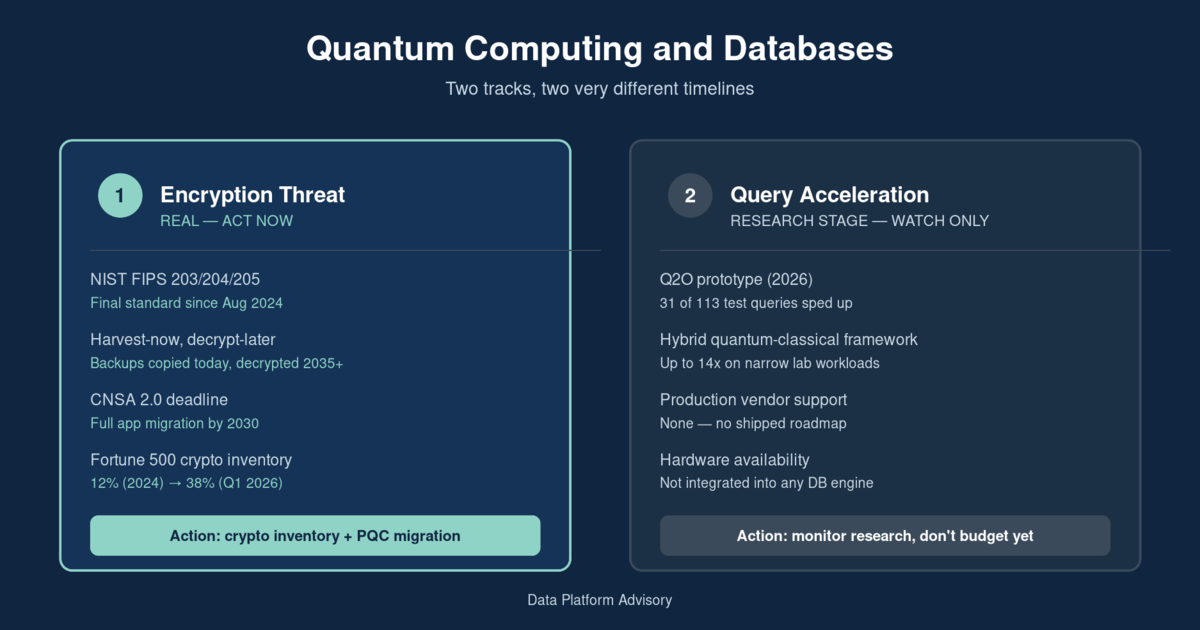
Quantum computing affects your database in two completely different ways, on two completely different timelines, and most of the coverage flattens them into one story. The threat to your encryption is real and the clock is already running — NIST finalized its post-quantum cryptography standards in August 2024, and a harvest-now-decrypt-later attacker doesn’t need a working quantum computer today to hurt you in 2032. The promise of quantum computers making your queries faster is a live, interesting research area — and it is nowhere near your production database. Conflating the two leads teams either to panic-buy PQC theater they don’t need yet, or to dismiss quantum entirely as science fiction and skip the encryption inventory they should have started already.
Why this gets confused so often
“Quantum” sells. Vendors attach it to everything from key management appliances to query optimizers, and press coverage of qubit-count milestones reads the same whether the milestone matters for cryptography, for optimization, or for neither. A database team scanning headlines sees “quantum breakthrough” attached to both a cryptographic risk and a performance pitch and reasonably assumes they’re on the same clock. They aren’t.
Key takeaways
- The cryptographic threat to databases is real and already actionable: NIST’s PQC standards (FIPS 203, 204, 205) have been final since August 2024, and CNSA 2.0 sets a 2030 deadline for full application migration.
- Most serious estimates still place a cryptographically relevant quantum computer 10-25 years out, but “harvest now, decrypt later” makes today’s encrypted backups tomorrow’s exposure regardless of that timeline.
- Quantum-accelerated query optimization is real research — not vaporware — but it’s running on small, lab-scale problems with no production database vendor shipping it.
- The correct 2026 action for most database teams is a crypto inventory and PQC migration plan, not a quantum-optimization pilot.
What’s actually coming: the encryption timeline
The hardware progress is genuine. By early 2026, the largest superconducting quantum processors had crossed 1,000 physical qubits, and Google Quantum AI demonstrated a system sustaining 1,200-1,450 logical qubits for roughly 18-23 minutes — a real step forward in error correction, the piece that’s been the actual bottleneck, not raw qubit count Quantum Security Defence.
Breaking RSA-2048 still requires on the order of four thousand error-corrected logical qubits running for days, and most researchers place a cryptographically relevant quantum computer somewhere between 2035 and 2050 Quantum Zeitgeist. That sounds like a “not my problem this decade” timeline — until you factor in harvest-now-decrypt-later. An adversary can copy your encrypted backups or database dumps today and simply hold them until decryption becomes feasible. If anything your database stores needs to stay confidential for more than 10-15 years — health records, long-lived financial data, national-security-adjacent data — the relevant deadline isn’t “when quantum computers arrive,” it’s “when did I stop encrypting this with something quantum-vulnerable.”
That’s precisely why NIST didn’t wait: FIPS 203, 204, and 205 became final standards in August 2024, closing an eight-year evaluation process, and CNSA 2.0 requires quantum-safe algorithms in all new national security systems by January 2027, with full application migration by 2030. By Q1 2026, roughly 38% of Fortune 500 firms had completed at least a partial cryptographic inventory, up from just 12% in late 2024 — the number that matters isn’t the deadline, it’s that a large, heterogeneous enterprise estate takes three to five years to fully migrate once resourced. We covered the database-specific side of that inventory and the cloud KMS timeline gap in more depth in two earlier posts, Your PQC Deadline Just Moved Up Four Years and The Post-Quantum Gap Hiding Inside Your Cloud Database KMS — this is the track that deserves budget and a project plan now, not in 2030.
What’s mostly noise: quantum-accelerated queries
The other quantum-and-databases story is quantum computers speeding up query optimization, join ordering, or transaction scheduling. This is legitimate academic work, not a scam — it’s just early. A 2026 research prototype called Q2O encodes the join-order problem as a model solvable on quantum hardware, translates the result into a plan hint, and feeds it back into PostgreSQL’s optimizer; across 113 test queries it produced speedups on 31 of them, with an average latency reduction of about 42% on the queries where it helped arXiv:2601.12123. A related hybrid quantum-classical framework reported up to a 14x improvement over a classical optimizer on specific workloads arXiv:2602.14263.
Those numbers are genuinely interesting for a research paper. What they are not is a production capability. These are lab benchmarks on a subset of queries, running against quantum hardware that isn’t available inside any commercial database engine, integrated by hand for a paper rather than shipped as a feature. No major database vendor — not Oracle, not Microsoft, not AWS, not Snowflake — offers quantum-accelerated query execution today, and none has announced a production timeline. If you’re evaluating this space the way you’d evaluate indexing strategy or a vector search architecture decision, you’re several years too early. Treat vendor pitches that lead with “quantum-powered” performance claims with the same skepticism you’d apply to any pre-product research demo repackaged as a roadmap slide.
What to actually do in 2026
For almost every database team, the action item this year is entirely on the encryption side, not the optimization side:
- Inventory your cryptography. Know which databases use which encryption at rest, in transit, and at the column level, and which algorithms back each one — you can’t migrate what you haven’t mapped.
- Separate TLS from data-at-rest keys. Confirming your connection string uses hybrid post-quantum TLS tells you nothing about whether your TDE or column-level encryption keys are on a PQC-ready path; those are managed by your cloud provider’s KMS on its own timeline.
- Flag your long-lived-confidentiality data specifically. Not everything needs to move first — data that only needs to stay confidential for two or three years faces a very different harvest-now-decrypt-later calculus than data that needs to stay confidential for twenty.
- Ignore quantum-speedup marketing for procurement decisions. Watch the research if it interests you, but don’t let it distract budget or attention from the migration that’s actually due.
If you’re not sure which category your database’s exposure falls into, that’s exactly the kind of gap worth a conversation before it becomes a deadline. Get in touch and we can map out where your systems actually stand.
Ivan Lima is a data engineer specializing in database modernization for AI systems. Get in touch if your database needs to be ready for what’s next.