Your AI Act Deadline Was Deferred. Your Database Debt Wasn't
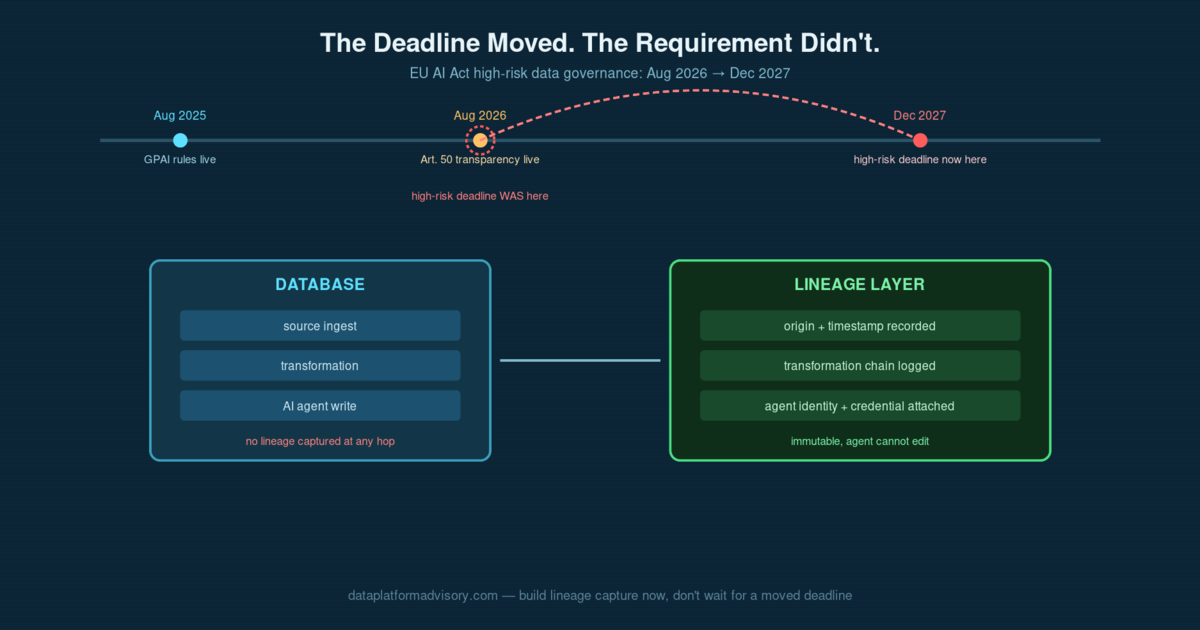
The EU AI Act’s high-risk data governance deadline — the one requiring provable data lineage for regulated AI systems — was pushed from August 2026 to December 2027 by the Digital Omnibus on AI, approved in June 2026. That deferral changed a date, not a requirement, and most databases still can’t answer the basic question underneath it: where did this row come from, and can you prove it.
What’s actually happening
Two different EU AI Act clocks are running, and conflating them is the mistake to avoid. The Article 50 transparency duties and the Act’s general application land on 2 August 2026 — already in effect as of this post — and require disclosure whenever someone interacts with an AI system or synthetic content, regardless of risk tier. Separately, the substantive high-risk obligations under Articles 9-15 — including Article 10’s data governance requirements and Article 12’s automatic event logging — were deferred by the Digital Omnibus on AI, given final Council approval on 29 June 2026, from 2 August 2026 to 2 December 2027 for Annex III high-risk systems.
The deferral happened because the harmonised technical standards that would give high-risk systems a presumption of conformity weren’t ready — not because regulators decided lineage and audit trails were less important. The requirements arriving in December 2027 are the same ones that were supposed to arrive in August 2026: Article 10 requires that training, validation, and testing datasets be relevant, representative, and traceable back to their origin; Article 12 requires automatic, tamper-evident logging of system events throughout the AI system’s operation. A system a company puts into production today still has to be conformant against that evidence trail in December 2027 — and reconstructing eighteen months of data provenance retroactively from a system that was never built to record it is far more expensive than capturing it as you go.
Separately from the EU timeline, the operational case for lineage is already independent of any single regulation. According to research compiled by Atlan, most database and data platform teams still can’t produce an attributable, end-to-end record of where a given piece of data originated, what transformed it, and which system — human or AI agent — last touched it. That gap doesn’t wait for a regulatory deadline to become a problem; it shows up the first time a customer, auditor, or incident responder asks a question the database has no way to answer.
Who this affects
Data engineering leads and DBAs own the pipelines where lineage either gets captured or doesn’t — at ingestion, at each transformation step, and at every point an AI agent reads from or writes to a table. If lineage isn’t designed into the pipeline architecture, it doesn’t exist after the fact; there’s no way to retroactively generate a record of something nobody logged. Compliance and legal teams, particularly at organizations operating in or selling into the EU, need an accurate read on which of their systems fall under Annex III high-risk categories (credit scoring, insurance pricing, employment decisions, and similar) and therefore inherit the December 2027 deadline versus which ones are already in scope for the August 2026 transparency duties. CTOs and engineering leadership are the ones who have to decide, right now, whether “we have eighteen extra months” is treated as breathing room or as a false signal that risks the same expensive, retroactive scramble that hits any team that waits for a deadline to become urgent before building for it.
A fourth group matters here specifically because of how AI changes the picture: any team giving AI agents read or write access to a database now has an additional lineage requirement that didn’t exist before agents were in the loop — not just where did this data come from, but which agent touched it, under what authority, and what did it change. That’s a new column in the lineage record, not an extension of an old one.
When this becomes a real problem
The nearest deadline that’s not deferred is already here: the Article 50 transparency duties took effect on 2 August 2026, roughly two weeks before this post. Any organization running a customer-facing chatbot, generating synthetic content, or using emotion recognition or biometric categorization needs disclosure mechanisms now, and those obligations sit on top of — not instead of — good data lineage practice, because you can’t disclose what an AI system is doing with data you can’t trace.
The high-risk data governance and record-keeping requirements land 2 December 2027 for Annex III systems, and 2 August 2028 for high-risk AI embedded in regulated products like medical devices and vehicles. Eighteen months sounds like room to breathe. It isn’t, for two reasons. First, the requirement itself didn’t change — only the date — so a system built without lineage in mind between now and 2027 accumulates the same retrofit debt whether the deadline is next month or two years out. Second, lineage and provenance tracking is infrastructure, not a policy document; it has to be designed into how a pipeline ingests, transforms, and serves data, and retrofitting that into a system already in production is a multi-quarter engineering project, not a paperwork exercise that can be compressed into the final weeks before a deadline.
How this actually plays out technically
Most databases today can answer “what is this row’s current value” but not “where did this row’s current value come from, through what transformations, touched by which processes.” That second question requires infrastructure most pipelines don’t have by default.
Lineage capture has to happen at write time, not reconstructed later. A typical pipeline pulls from a source system, runs it through one or more transformation steps (dbt models, ETL jobs, an AI agent’s own writes), and lands it in a serving table. Without an explicit lineage layer, each of those hops discards the “where did this come from” information — the serving table just has a value, with no record of its ancestry. Retrofitting this after the fact means either accepting a gap in your lineage history before the retrofit date, or attempting a forensic reconstruction from logs that were never designed for this purpose and usually don’t have the retention or structure to support it.
AI agent writes need to be lineage events, not anonymous transactions. When an agent updates a row, the standard database transaction log records that a change happened and roughly when — but not, by default, which agent, acting under which credential, in service of what task. Under Article 12’s automatic logging requirement, and under any sane operational governance model independent of the Act, that context needs to be captured as structured metadata alongside the write itself: agent identity, credential scope, triggering task or prompt reference, and timestamp, in a log the agent itself cannot modify.
Provenance and lineage are different things that get conflated. Provenance is where data originated — the source system, the point of collection, and under what consent or authorization. Lineage is everything that happened to it afterward — every transformation, join, and aggregation between origin and its current form. A compliant answer to “prove this data is accurate and traceable” needs both: the origin story and the full chain of custody since.
Tooling exists for this, but it needs to be pointed at the right target. Open-source lineage standards like OpenLineage, and platform-native lineage graphs in tools like dbt, Airflow, and most modern data catalogs, can capture transformation-level lineage automatically once instrumented — the gap is usually that teams adopt these tools for observability or debugging and never extend that same instrumentation to cover AI agent access patterns, which are a newer and faster-moving category of database interaction than the batch ETL jobs these tools were originally built to trace.
Actions to take now
- Classify which of your AI systems fall under Annex III high-risk categories versus which are only in scope for the already-active Article 50 transparency duties. This determines which deadline actually applies and prevents both false urgency and false relief.
- Audit your current pipelines for lineage gaps today, table by table: for your five or ten most business-critical tables, can you currently produce an end-to-end record of where each row originated and what has transformed it since? Most teams find the honest answer is no, and that’s the actual starting point.
- Add lineage capture at the transformation layer, not as an afterthought query. If you’re using dbt, its native lineage graph is a starting point but needs to be paired with runtime metadata, not just build-time DAG structure. If you’re hand-rolling ETL, add explicit source/transformation metadata columns or a companion lineage table before adding new pipelines, not after.
- Instrument AI agent database access as structured, immutable log entries — agent identity, credential, task reference, and affected rows — separate from and unmodifiable by the agent itself. This is the specific gap most teams have today: general query logging exists, agent-attributable lineage usually doesn’t.
- Pick one Annex III-adjacent system, if you have one, and run it through a full lineage exercise now — treat it as a pilot for the December 2027 requirement rather than waiting for the deadline to force the exercise under time pressure.
- Set a retention and immutability policy for lineage records themselves. A lineage log that can be edited or deleted by the same systems it’s supposed to be auditing doesn’t satisfy the intent of Article 12, even if it technically exists.
- Revisit this classification and your lineage coverage on a fixed schedule (quarterly is reasonable) rather than once — the Digital Omnibus deferral is a reminder that EU AI Act dates have already moved once, and your data governance posture should be resilient to timeline shifts, not built around a single fixed date.
Key takeaways
- The EU AI Act’s high-risk data governance and record-keeping requirements (Articles 9-15) were deferred from 2 August 2026 to 2 December 2027 by the Digital Omnibus on AI, approved 29 June 2026 — the requirements themselves didn’t change.
- The Article 50 transparency duties and general application of the Act were not deferred and took effect 2 August 2026.
- Data lineage — the ability to trace a row back to its origin and every transformation since — is infrastructure that has to be built into a pipeline at write time; it can’t be reliably reconstructed retroactively.
- AI agent database writes need to be captured as structured, agent-attributable lineage events, not folded into anonymous transaction logs.
- Waiting for the December 2027 deadline to start building lineage capture creates the same retrofit cost the deferral was meant to give teams time to avoid.
This connects to governance ground already covered on this site: the propose/apply permission line in AI Agent Guardrails for Databases, and the five-stage review process in A Human-in-the-Loop Framework for AI Database Code — both describe how a change gets approved, while lineage is the record of what actually happened afterward, which is what an auditor or regulator asks for. The AI-readiness data referenced elsewhere on this site — only 5-7% of enterprises report fully AI-ready data — is, in no small part, a lineage and provenance gap wearing a different name.
If your pipelines can’t yet answer where a row came from and which agent last touched it, that’s a gap worth closing before it’s a compliance finding. Get in touch if you want a lineage and data governance assessment for your database layer.
Ivan Lima is a data engineer specializing in database modernization for AI systems. Get in touch if your database needs to be ready for what’s next.