Semantic Rot: When Embedding Upgrades Break Vector Search
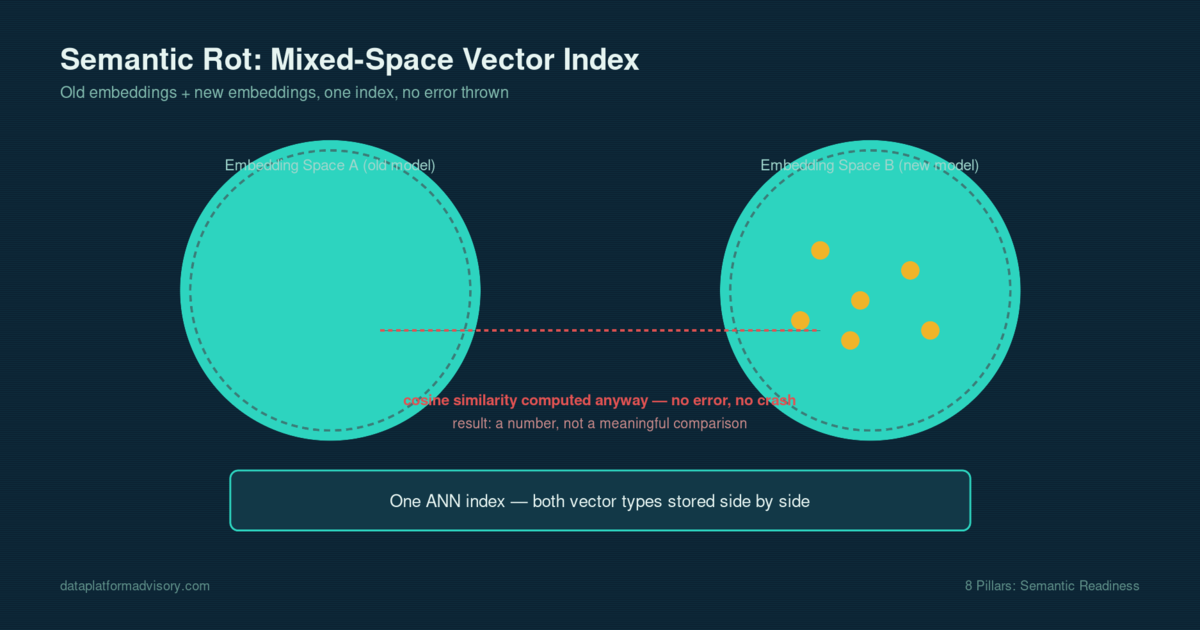
When a vendor quietly updates the embedding model behind an API, or a team upgrades to a newer, better-benchmarking model, vectors written before and after the change end up living in incompatible mathematical spaces — but the vector index doesn’t know that, and neither does the application. Retrieval keeps returning results. They’re just wrong, and nothing in the stack tells you so. This is embedding drift, and it is one of the least understood operational risks in production AI systems built on vector search.
What’s actually happening
Every embedding model maps text (or images, audio, code) into a high-dimensional vector space, and “similar meaning” is encoded as “close together” in that space. The geometry of that space — which directions mean what, which clusters sit near each other — is specific to the model that produced it. Two different embedding models, even ones with the same output dimensionality, generally do not produce compatible spaces. A vector from model A and a vector from model B can be the same length, pass every schema check, and still mean something entirely different when compared to each other.
That matters because production vector indexes accumulate vectors over long periods, and models change underneath them constantly: a provider updates the model behind an embeddings API endpoint, a team fine-tunes a new version for better domain performance, or a migration to a new vector database silently re-triggers embedding with a different default model. If the corpus isn’t fully re-embedded and re-indexed atomically, the index ends up holding a mix of old-space and new-space vectors side by side.
The failure mode is specifically insidious because of what it doesn’t do. As one recent analysis of production embedding pipelines put it, two models with the same output dimension are particularly dangerous because there’s no dimension mismatch to crash on — the system just silently returns garbage for some fraction of queries (Gary Stafford, “Different Embedding Models, Different Spaces,” Medium, 2026). No exception is thrown. No health check fails. The query that hits a recently re-indexed document returns excellent results; the same query structure against an older, un-migrated document returns nonsense — and nothing in the retrieval layer signals that the comparison itself is invalid.
This is distinct from — and compounds — the two other slower-moving drift problems that already erode retrieval quality over time: query distribution shift, where users start asking about things the corpus and eval set never anticipated, and corpus drift, where the underlying content itself evolves. Embedding model drift is the acute version: a single migration event that instantly and silently corrupts a slice of the index rather than degrading it gradually.
Who this hits
This is squarely a data engineering and ML/AI platform problem, but it surfaces as a business problem owned by whoever is accountable for the AI feature built on top of the vector store. In practice that’s several overlapping groups:
Data engineers and DBAs who own the vector database or the pipeline that populates it are the ones who actually trigger the drift, usually without realizing it, during what looks like a routine dependency bump or provider migration. Platform and ML engineering leads are accountable for the RAG or semantic search system’s quality metrics and are the ones who get paged when user-facing answer quality quietly degrades with no obvious cause. Product owners of AI features — support copilots, internal search, recommendation systems — are the ones who hear “search feels worse lately” from users without any corresponding alert firing. And any organization using a third-party embeddings API is exposed to a version of this risk they don’t fully control: the provider can change the model behind an endpoint without a breaking API change, because from the API contract’s perspective nothing broke.
Organizations running vector search over regulated or high-stakes content — legal document retrieval, clinical decision support, financial research — carry the highest exposure, because silently wrong retrieval in those contexts isn’t just an annoyance, it’s a correctness and liability problem that’s much harder to detect than a normal outage precisely because everything appears to be working. That correctness gap is the same category of problem covered in Is Your Database AI-Ready?, where only 5-7% of enterprises report data that’s genuinely ready for AI workloads — embedding drift is one concrete way that gap manifests after the data has already been deemed “ready.”
When this becomes a real risk
This isn’t a speculative future problem — it’s already happening in production systems today, and it’s getting more common as the ecosystem matures. A few concrete timeline drivers:
Embedding model release cadence has accelerated sharply. Teams evaluating “best embedding model for RAG” guides now do so on close to a quarterly basis as new models top MTEB leaderboards, which means the temptation (and business case) to upgrade recurs constantly rather than being a rare, carefully-planned event. Re-embedding cost has become a real budget line rather than an afterthought — one production cost breakdown put re-embedding 50 million documents at roughly 25 billion tokens, translating to real compute-hours and real dollars depending on provider pricing (production RAG migration guidance, Medium, 2026). That cost pressure is exactly what pushes teams toward partial, staged, or rushed migrations — the conditions under which mixed-space indexes happen.
At the same time, research specifically targeting this problem has only emerged very recently. A 2026 paper introducing “Drift-Adapter,” a lightweight transformation layer that maps queries into a legacy embedding space so an old ANN index can keep serving during a model transition, frames the near-zero-downtime embedding migration problem as an open, current challenge rather than a solved one — the paper reports recovering 95-99% of full re-embedding recall with under 10 microseconds of added query latency, which is only meaningful if you accept that the naive migration path is broken today (arXiv:2509.23471, “Drift-Adapter,” 2026). In other words: the fact that credible new tooling is being built specifically to solve this is itself evidence the underlying failure mode is live and unresolved industry-wide right now, not a three-to-five-year-out concern.
How it plays out in a real environment
The typical sequence looks mundane right up until it isn’t. A team is running a RAG-backed support tool or internal search product on top of a vector database — pgvector, Pinecone, Weaviate, Milvus, whatever. Someone upgrades the embeddings provider’s SDK, or the provider deprecates an old model version and auto-routes calls to a newer one, or an engineer decides to swap to a model that scores better on a public benchmark. New content gets embedded with the new model going forward. Existing vectors in the index — potentially millions of them, built up over months — stay exactly as they were, encoded in the old model’s space.
Nothing about this trips a schema validator. Vector dimensions often match (many embedding families standardize on common dimensions like 768, 1024, or 1536), so there’s no crash on write or on query. The index keeps accepting inserts and keeps returning nearest neighbors for every query, because cosine similarity or dot product will happily compute a number between any two vectors of matching dimension — it just won’t be a meaningful number when the vectors come from different spaces.
What actually gets observed downstream is subtler and easy to misattribute: retrieval quality that seems inconsistent rather than uniformly bad, support tickets that mention search feeling “hit or miss,” an eval suite that doesn’t catch it because eval sets are usually run against a fixed snapshot rather than continuously re-validated against the live, evolving index, and no infrastructure alert anywhere, because nothing is actually erroring — the system is doing exactly what it was told, just against numbers that no longer mean what the code assumes they mean. Teams often burn real diagnostic time on hallucination theories, prompt tuning, or reranking model swaps before anyone thinks to check whether every vector in the index actually came from the same embedding model. It’s a similar diagnostic trap to the one described in Diagnosing and Fixing a Slow Query — the symptom points everywhere except the actual cause until someone checks the layer underneath the one they assumed was stable.
Actions to take now
- Tag every vector with its embedding model and version at write time. This is the single highest-leverage, lowest-cost fix. A
model_versionmetadata field on every vector turns an invisible problem into a queryable one — you can immediately find out whether your index is mixed, and filter or route around old vectors while you migrate. - Audit your current index today for mixed-model contamination. If you’ve ever changed embedding providers, upgraded a model, or migrated vector databases without a full, verified re-embed, assume contamination until you’ve checked. Sample vectors from different time periods and confirm they cluster consistently for known-similar content.
- Treat “the provider changed the model behind the endpoint” as a real risk, not a hypothetical. If you use a hosted embeddings API without an explicitly pinned model version, add monitoring for unannounced output-distribution shifts, or push your vendor for an explicit version-pinning guarantee.
- Adopt a shadow-index or dual-index migration pattern for any future embedding model change. Build the new index alongside the old one, route a percentage of query traffic to compare recall and relevance side by side, and only cut over once validated — never do an in-place, partial re-embed of a live index.
- Build a small labeled evaluation set now, before you need it. A representative sample with known-good retrieval results lets you quantitatively test whether a candidate model upgrade is actually worth the migration cost (a common threshold used in practice is requiring at least a 3-5% NDCG@10 improvement to justify a full re-embed) and lets you detect drift after the fact rather than relying on user complaints.
- Budget re-embedding as a recurring line item, not a one-time migration cost. Given how fast embedding models are iterating, plan for periodic full re-embeds as an ongoing operational cost of running vector search, the same way you’d budget for index maintenance or storage growth.
- For new builds, evaluate multimodal-capable embedding models up front if there’s any realistic chance you’ll add images, PDFs, or other content types within the next 6-12 months — starting there avoids a forced full migration later purely to add a modality.
Key takeaways
- Vectors from different embedding models can share the same dimensionality and pass every technical check while being semantically incompatible — comparisons between them produce numbers, just not meaningful ones.
- Embedding drift produces no crash, no schema error, and no automatic alert; it shows up as inconsistent, hard-to-attribute retrieval quality that teams often misdiagnose as a prompting or reranking problem.
- The risk is active today, not a future concern — embedding model release cadence has accelerated, and dedicated research (like Drift-Adapter) treating this as an unsolved production problem is emerging right now.
- Tagging every vector with its embedding model version at write time is the cheapest, highest-leverage mitigation available and should be standard practice.
- Any embedding model change should go through a shadow or dual-index migration with explicit recall validation before cutover — never an in-place partial re-embed.
If your organization is running vector search or RAG in production and can’t currently answer “which embedding model produced every vector in this index,” that’s worth fixing before the next model upgrade, not after retrieval quality complaints start coming in. Get in touch or see how we approach database and data platform modernization if you want a second set of eyes on your vector infrastructure.
Ivan Lima is a data engineer specializing in database modernization for AI systems. Get in touch if your database needs to be ready for what’s next.