AI Agent Fan-Out Is the New Thundering Herd for Databases
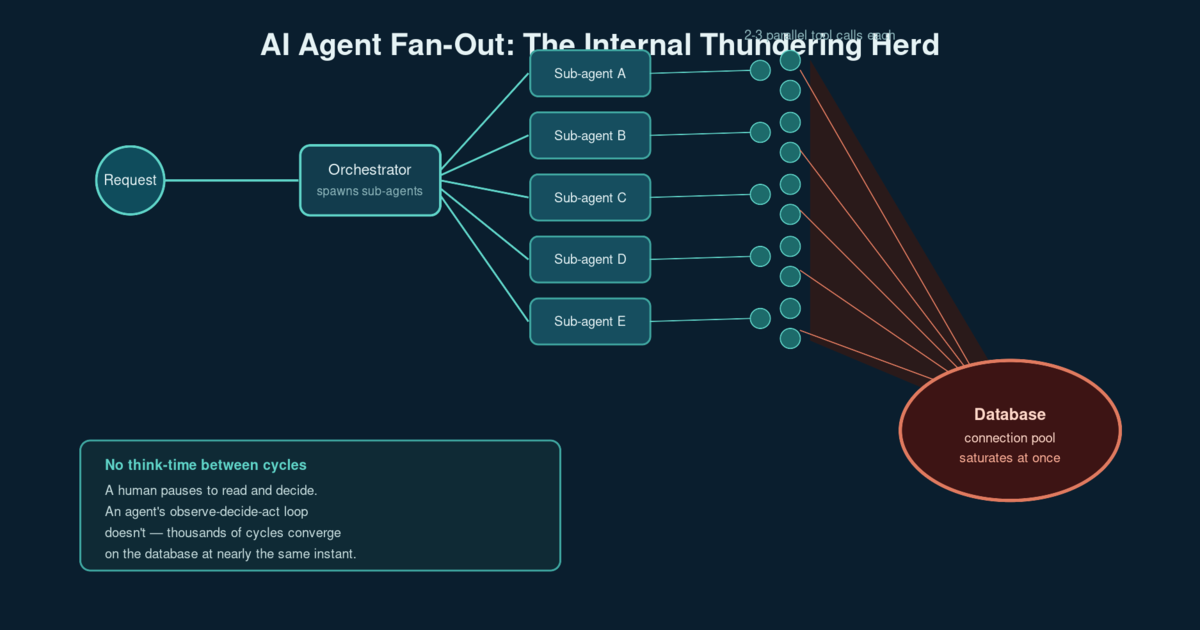
A thundering herd used to be something that happened to your database — a cache expired, a service came back online, a notification fired to a million users, and everyone hit the same resource at once. Agentic AI creates the same failure mode from the inside: an orchestrator fans a single request out into dozens of parallel sub-agent tool calls, all of which read, write, and retry against the same database at nearly the same moment, purely because that’s how the architecture was designed to work. No outage triggers it. No external event has to occur. The synchronization is the feature, and it can saturate a database non-linearly, with almost no warning between “fine” and “down.”
What’s actually happening
Traditional thundering herd problems have a known playbook: exponential backoff with jitter, circuit breakers, staggered cache TTLs. That playbook assumes you can identify where the synchronized load originated — a deploy, a restart, a timer. Agentic systems break that assumption because the orchestration pattern itself generates the herd on purpose, at machine speed, every single time it runs.
Anthropic’s own guidance on building effective agents describes parallelization as a core design pattern: an orchestrator spawns sub-agents to work simultaneously, each sub-agent calls multiple tools in parallel, and results converge back to the orchestrator. That pattern can cut task completion time by as much as 90% for complex queries — which is exactly why teams are building it into production systems. But a single user request that used to generate one or two database queries can now generate dozens of downstream operations within seconds, all converging on the same connection pool, the same cache layer, or the same table at nearly the same instant (Cockroach Labs, “The Thundering Herd Problem in Agentic AI,” June 2026).
Datadog’s 2026 State of AI Engineering report found that 18% of agentic application requests already made three or more service calls — in a traditional web app, three calls per request is a complex interaction; in an agentic system, it’s a simple workflow. The same report found rate-limit errors accounted for 60% of all LLM call span errors in February 2026 alone, nearly 8.4 million errors in a single month, which is what happens when retry logic was never designed for machine-speed, multi-step workflows in the first place (Datadog, State of AI Engineering, 2026).
Cockroach Labs’ own benchmarking against a real transactional workload — a travel-booking agent parsing intent, querying availability, and attempting a booking — found that both PostgreSQL and CockroachDB tracked closely at low concurrency, but PostgreSQL began shedding throughput sharply once concurrent agents crossed a range between 700 and 1,000. By 5,000 concurrent agents, PostgreSQL throughput had dropped to roughly 57 operations per second, while the distributed alternative held near 130. The specific numbers are vendor-published and worth validating against your own workload, but the shape of the curve is the finding that matters: systems don’t degrade gradually under agent load in a way that gives you time to react. They hold, then drop sharply, and nothing observed at hundreds of concurrent agents predicts what happens at thousands.
Who this affects
This lands squarely on the people who own database capacity and incident response, not just the teams building agent frameworks:
- DBAs and database platform engineers who size connection pools, set circuit-breaker thresholds, and get paged when throughput craters with no obvious external cause.
- Site reliability and infrastructure engineers who own capacity planning and load testing, and who are used to modeling human traffic patterns rather than machine-speed fan-out.
- AI/agent platform teams who choose orchestration patterns (parallel sub-agents, tool-calling frameworks, retry policies) without necessarily owning — or even visualizing — the downstream database consequences of those choices.
- Engineering leadership and CTOs who greenlight agentic features for their latency and throughput wins without a corresponding review of what happens to shared infrastructure when usage scales from a pilot’s dozens of concurrent agents to production’s thousands.
This is a different failure mode from an agent making a bad recovery call during an incident — this one happens during normal, successful operation, simply because the architecture is working as designed at scale. The organizational risk is that this failure pattern rarely gets attributed to its real cause. Cockroach Labs notes that these incidents are more likely to be logged as “connection pool saturation,” “database latency,” or “retrieval-layer failure” than as agent-triggered events — one customer support team traced a 40-minute retrieval-layer outage, caused by a nightly cache refresh synchronizing expiry across roughly 3,000 agents that then hit the same semantically identical queries simultaneously, back to its actual cause two weeks later, during an architecture review rather than the incident response itself.
When this becomes a real risk
This isn’t a speculative, multi-year-horizon concern — it’s already showing up in production benchmarks and postmortems in 2026, and it gets worse, not better, as agentic adoption scales. Three factors compress the timeline:
First, the volume of agentic traffic is growing fast; the Datadog figures above (18% of requests already at 3+ service calls, 8.4 million rate-limit errors in a single month) describe current production conditions, not a future scenario. Second, most teams’ load testing still models human-shaped traffic — staging environments rarely expose the 700–1,000-agent inflection point Cockroach Labs found, because nobody tests at that concurrency until production forces the issue. Third, the AI Incidents Database recorded a 21% year-over-year rise in AI-related incidents from 2024 to 2025, with monthly reported incidents climbing from roughly 50 in early 2020 to nearly 500 by January 2026 — a trend line, not an isolated data point.
The realistic near-term window is the next 6-18 months: as more teams move agentic features from pilot to production scale, the gap between “worked fine in staging” and “saturated in production” is where this risk concentrates. Teams running agent pilots today at low concurrency are, almost by definition, below the saturation curve’s inflection point — which is exactly why the risk is easy to underestimate until it isn’t.
How it plays out in a real database environment
Three specific patterns keep recurring, and each has a distinct mechanism:
Write convergence during agent fan-in. An orchestrator dispatches work to ten specialist agents at once. Because they started together and the work was roughly evenly distributed, they tend to finish together too — and all ten write their results back to shared state at nearly the same moment. This isn’t triggered by an outage or a timer; it’s triggered by completion, and every parallelized workflow produces it by design.
Correlated cache expiry. Classic cache stampedes are already a known failure mode: a cached result expires, and every dependent client falls back to the database at once. Agentic systems create a semantically correlated version of this. Thousands of agents sharing a knowledge base or tool-result cache with uniform TTLs don’t just hit the database at the same time — they hit the same specific queries, because they’re often working semantically similar tasks: support agents handling similar ticket types, booking agents querying overlapping routes, research agents pulling the same regulatory documents. A cache miss under those conditions doesn’t spread load across many different queries; it concentrates it on a handful of hot ones.
Multi-step retry storms. When a downstream service or the database itself hiccups, agent frameworks often retry aggressively and automatically, by framework default rather than deliberate application logic — and critically, they frequently retry the entire multi-step workflow from the last durable checkpoint, not just the failed call. If checkpoint granularity is coarse, a brief transient failure triggers a synchronized re-run of substantial compute and database work across thousands of sessions simultaneously, turning a blip into a sustained outage.
Underneath all three is a structural difference from human traffic: a person using an application has think-time between actions — reading a response, deciding what to click next — that naturally throttles downstream load. An agent’s observe-decide-act loop has no equivalent pause. When an orchestrator spawns five sub-agents each running two or three tool calls in parallel, that’s ten to fifteen simultaneous execution cycles from one user request; scaled to a thousand concurrent users, that’s ten to fifteen thousand simultaneous cycles hitting the database with nothing waiting and nothing throttling — the same underlying traffic-shape mismatch that’s already driving database billing minimums built for human traffic to blow past budget.
Actions to take now
- Instrument fan-out ratio, not just request count. Add observability that ties agent-session activity to downstream database operations — tool calls per session, sub-agent counts per orchestrated request, and query volume per session — so a saturation event can actually be traced back to the orchestration pattern that caused it, rather than showing up only as generic “connection pool exhausted” alerts.
- Load-test past your expected concurrency, not up to it. If your current pilot runs at a few hundred concurrent agents, test to several thousand before you assume the architecture holds at scale — the inflection point in published benchmarks sits around 700–1,000 concurrent agents, and staging environments built around current usage will not expose it.
- Add jitter inside the agent framework, not just at the infrastructure layer. Infrastructure-level backoff handles externally triggered retry storms; it does nothing for synchronized completion of parallel sub-agents. Stagger sub-agent task dispatch with randomized delays, and assign jittered TTL offsets at cache population time rather than using a single uniform expiry.
- Size connection pools for fan-out ratio, not user count. A web application assumes roughly one connection per active user; an agentic workflow can require several simultaneous connections per user as sub-agents execute in parallel. Recalculate pool sizing against expected fan-out, and treat it as a workload-control setting, not a one-time efficiency tweak.
- Tune circuit breakers to trip on behavioral drift, not just error rate. Agentic write pressure can build gradually and saturate a database before error rates move meaningfully. Add signals like tool-calls-per-session, latency growth, and abnormal write volume as independent circuit-breaker triggers, ahead of hard error thresholds.
- Audit checkpoint granularity in your agent workflows. Determine the blast radius if a transient failure triggers a full workflow retry across every active session simultaneously. Finer-grained, more frequent checkpoints reduce how much work — and how much synchronized database load — a single retry can regenerate.
- Review write patterns for hotspot risk before, not after, scale. Sequential primary keys concentrate contention during fan-in events; hash-distributed keys or append-only patterns spread it. This is a schema decision, and it gets significantly harder to change once you’re already at production scale.
- Put agentic concurrency on the same capacity-planning cadence as any other growth driver. Treat agent adoption curves — not just user growth — as a first-class input to database capacity reviews, since agent-driven load can scale non-linearly relative to headcount or user growth in a way traditional forecasting models won’t catch — the same blind spot behind AI teams quietly cloning production databases into every region their compute lives in.
Key takeaways
- Agentic AI creates a thundering-herd condition that originates inside your own architecture — fan-out, parallel tool calls, and shared checkpoints generate synchronized database load without any external trigger.
- Database concurrency under agent load doesn’t degrade gradually; published benchmarks show a sharp inflection point around 700-1,000 concurrent agents, invisible in smaller-scale staging tests.
- The three recurring failure patterns are write convergence during fan-in, correlated cache expiry on semantically similar queries, and multi-step retry storms that re-run entire workflows rather than single failed calls.
- These incidents commonly get logged as generic connection-pool or latency failures, hiding the agentic root cause from postmortems unless observability explicitly connects agent behavior to database load.
- Fixes require putting jitter and staggered dispatch inside the agent framework itself, sizing connection pools for fan-out ratio, and tuning circuit breakers to catch behavioral drift ahead of hard error-rate thresholds.
Resiliency planning built for human-scale traffic patterns doesn’t automatically survive contact with agentic orchestration — the assumptions have to be re-tested, not just re-applied. If you’re scaling agentic features and want a second set of eyes on whether your database’s capacity planning and failover design actually accounts for agent fan-out, get in touch.
Ivan Lima is a data engineer specializing in database modernization for AI systems. Get in touch if your database needs to be ready for what’s next.