Your Database Failover Passed. Your AI Agents Didn't.
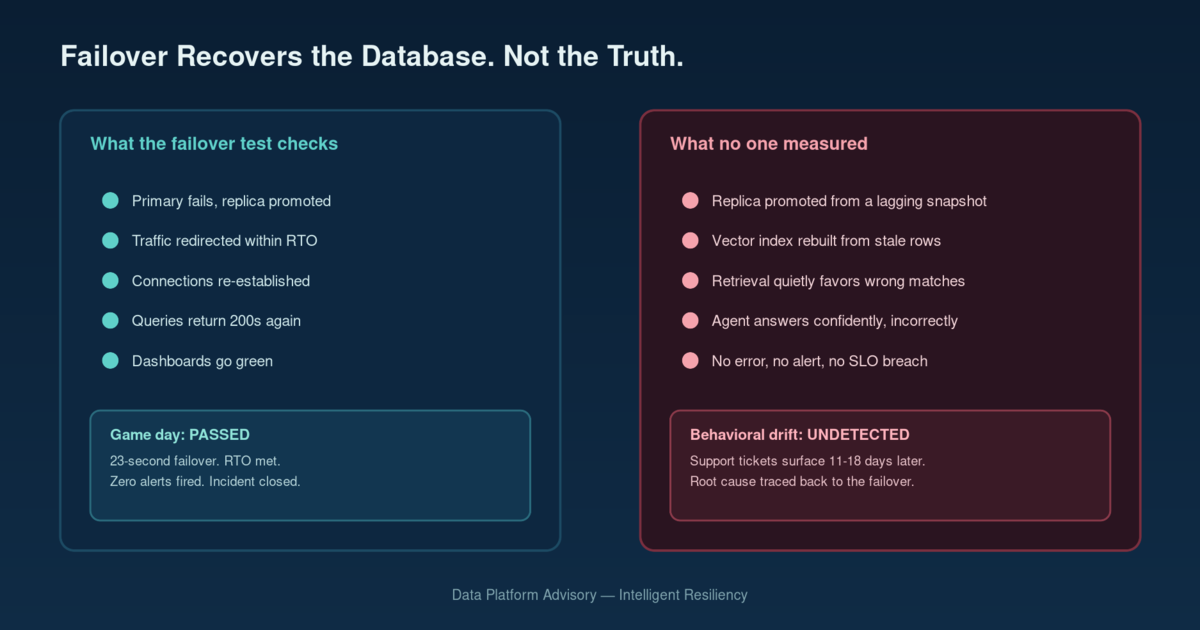
A failover game day can pass every check you’ve defined — replica promoted, traffic redirected inside your RTO window, zero alerts, dashboards green — and still leave your AI agents reasoning over the wrong version of the truth. Database resiliency testing was built to answer one question: did the system come back up? For agentic systems sitting on top of that database, that’s no longer the question that matters. The right question is whether what came back is what the agent thinks it is, and most resiliency programs have no test for that at all.
What’s actually happening
Chaos engineering and disaster-recovery testing have spent fifteen years perfecting one measurement: operational recovery. Is the service up, is latency within SLA, did the failover complete inside the recovery time objective. For a stateless web tier or a transactional system with human clients, that measurement is basically sufficient — a human notices when an answer looks wrong and escalates.
An AI agent doesn’t have that instinct. It has been shown, repeatedly, to produce fluent, structurally correct, confidently wrong answers when the data underneath it has silently shifted — and a standard chaos or DR test cannot see that failure at all, because nothing about it looks like an outage. A recent industry analysis of production RAG and agentic pipelines catalogued this precisely: teams ran thorough chaos suites — pod failures, network partitions, database failovers — watched everything recover cleanly, shipped with confidence, and then had support tickets surface days or weeks later because the AI was producing wrong answers with no alert ever having fired and no SLO ever having been breached (DZone, “Chaos Engineering Has a Blind Spot. Agentic AI Lives in It.,” May 2026). One documented case ran chaos injection against a RAG-based support chatbot, saw 99.99% uptime and clean latency recovery post-chaos, and three days later found the chatbot answering return-policy questions incorrectly in 7% of cases — traced back to retrieval quietly favoring faster, lower-precision vector matches after the recovery event. Infrastructure recovered. The behavior of the system it was built to serve didn’t.
The database-specific version of this is a failover or restore that succeeds by every infrastructure metric while quietly changing what a vector index, a materialized view, or a replica’s row-level state actually contains relative to what it contained a moment before the incident — a promoted replica that lagged the primary by minutes, a point-in-time restore that landed a few transactions short, a vector index rebuilt from a slightly stale snapshot. None of those are failures by RTO/RPO standards. Your recovery point objective was met. But an agent querying that recovered database has no way of knowing its retrieval layer is now returning subtly different — sometimes contradictory — results than it was an hour earlier, and it will answer with the same confidence either way.
Who this affects
This sits squarely with the teams who own database resiliency and disaster-recovery testing, plus the teams downstream of it who assumed “recovery verified” meant “safe to keep serving agent traffic”:
DBAs and database reliability engineers who design and run failover drills and game days, and who currently define “pass” using RTO, RPO, and connection-recovery metrics that say nothing about data consistency from an AI consumer’s point of view. Platform and AI infrastructure teams who built retrieval pipelines, RAG systems, or agent tool-calling on top of a database that they assume behaves identically before and after a recovery event, without ever having tested that assumption directly. SRE and incident-response teams, because when this failure surfaces, it does not look like an infrastructure incident — it looks like a product-quality complaint, a support ticket, or a silent accuracy drop that gets investigated (if it gets investigated at all) by a completely different team, weeks after the triggering failover. And engineering leadership approving DR budgets and game-day cadences based on infrastructure-recovery metrics that, for any agent-facing system, are now measuring the wrong thing.
This is a distinct failure mode from an agent making a bad recovery decision mid-incident or agent-driven load saturating a connection pool. Those happen because an agent does something. This happens when the recovery process itself works exactly as designed, and the database comes back with subtly different contents than it had before — a supply problem, not a demand problem.
When this becomes a real risk
This is already happening in production, not a multi-year-horizon concern, and it compounds as more of the query surface in front of a database shifts from human clients to agents. Three factors set the timeline.
First, the reported cases are current: the DZone analysis draws on production accounts from more than 25 engineering teams active in 2026, describing failures discovered within days to weeks of a recovery or chaos event, not years. Second, chaos and DR practice for databases has genuinely not caught up — a January 2026 game-day report cited in the same research cycle still measured success purely as failover completing inside a 30-second target, with no behavioral or retrieval-correctness check attached at all (DZone, “Chaos Engineering Has a Blind Spot,” citing production game-day data, 2026). Third, detection lag is the part that makes this worse over time, not better: because nothing alerts, these gaps get found by users noticing wrong answers, or by an unrelated architecture review weeks later — one documented case took two weeks to trace a retrieval-layer outage back to its actual root cause, a synchronized cache-expiry event, purely because nobody was looking for a behavioral signal in the first place. As more production systems move from “database serves a human-facing app” to “database serves an agent that acts on what it reads,” the number of recovery events silently mismeasured this way only grows.
How this actually plays out in a database environment
The mechanics run through three places database teams already touch during failover, restore, and recovery testing, but don’t currently instrument for correctness:
Replica promotion under lag. A standard failover promotes the most current available replica, but “most current” is relative — a replica lagging the primary by even a few seconds at the moment of failure can be promoted with a materially different row-level state than what agents were reading a moment earlier. For a transactional workload, that’s a known, bounded risk with well-understood mitigations. For a RAG pipeline querying that same database for retrieval context, a few seconds of lag can mean the difference between a document existing in the index or not, and the agent has no signal that the ground it’s standing on just shifted.
Snapshot-based restore and stale vector state. A point-in-time restore or a vector index rebuilt from a backup snapshot reintroduces exactly the kind of staleness the DZone research calls out as its most common failure vector: retrieval precision quietly degrading because the index no longer reflects the freshest embeddings, while every infrastructure signal — query latency, error rate, connection health — stays green. Data Platform Advisory covered the mechanics of this staleness problem directly in why embedding models eventually break your vector index and in how silent embedding drift degrades vector search — a failover or restore event is simply a fast, discrete way to trigger the same drift that normally accumulates gradually.
No fencing on stale reads during and after promotion. The same discipline that prevents split-brain during failover — monotonic writer epochs, fencing old writers, rejecting stale activation requests — has a read-side analog that almost no team implements: nothing fences an agent’s retrieval query against reading from a replica or index that hasn’t yet caught up to the new authoritative state. Failover engineering has spent years hardening the write path against exactly this class of staleness — quorum, fencing tokens, and epoch checks that reject a write from a superseded actor (OneUptime, “How to Prevent Split-Brain and Stale Writes During Failover and Failback,” September 2026) — but almost nobody applies an equivalent check to a read path an agent uses to decide what’s true. A stale write gets rejected. A stale read gets served with full confidence.
Actions to take now
- Add a behavioral exit criterion to your next failover drill, not just an operational one. Before the next game day, define what “recovered correctly” means for retrieval and agent-facing queries specifically — not just RTO met and connections restored.
- Lock a behavioral baseline before you test. Sample 50-100 representative retrieval queries and their expected results before injecting any failure, so you have something concrete to compare against after recovery — an unlocked, ad hoc comparison after the fact is close to useless.
- Run a stale-snapshot or lagging-replica injection as its own chaos experiment, separate from your standard “kill the primary” test — replace the index or replica with a deliberately stale version and measure retrieval precision drift, not just recovery time.
- Instrument retrieval precision and groundedness as first-class signals, alongside latency and error rate, on the same dashboards your DBAs already watch during and after a failover event.
- Apply read-side fencing where you already apply write-side fencing. If your failover design already uses epochs or fencing tokens to reject stale writes, extend the same check to retrieval and agent-facing read paths so a query can’t silently serve from a not-yet-caught-up replica or index.
- Sample and score agent outputs for a defined window after every failover or restore, not just during the drill itself — the DZone research’s own benchmark is a useful starting point: outputs should stay within 3-5% of baseline behavioral scores across at least 50 sampled queries before you call the recovery complete.
- Assign explicit ownership for the gap between “infrastructure recovered” and “agent behavior verified.” Right now this frequently falls into a crack between the DBA/SRE team that owns the failover and the AI/platform team that owns the agent — name an owner before the next incident forces the question.
Key takeaways
- Standard failover and DR tests measure RTO, RPO, and uptime — none of which detect whether a recovered database is returning subtly different or stale content to an AI agent.
- Documented production cases show agents producing confident, wrong answers for days to weeks after a recovery event that passed every infrastructure check, with no alert or SLO breach at any point.
- Replica promotion under lag and snapshot-based restores are the two most common database-specific triggers, because both can reintroduce staleness into a vector index or retrieval layer without touching operational metrics.
- The write-side fencing discipline (quorum, epochs, rejecting stale writers) that database teams already use to prevent split-brain has no equivalent on the read side for agent retrieval queries — that’s the actual gap.
- Closing this requires a behavioral exit criterion and a locked baseline added to existing failover drills, not a separate program — the infrastructure test you already run is the right place to add it.
Database resiliency programs that were built for human-facing systems are running one test short for the systems agents actually rely on. If your last DR drill measured uptime and nothing else, Data Platform Advisory can help you find out what your agents are actually reading after the database comes back — reach out before a production incident finds it for you.
Ivan Lima is a data engineer specializing in database modernization for AI systems. Get in touch if your database needs to be ready for what’s next.