Nobody Set a Retention Policy for Your AI Agent's Memory
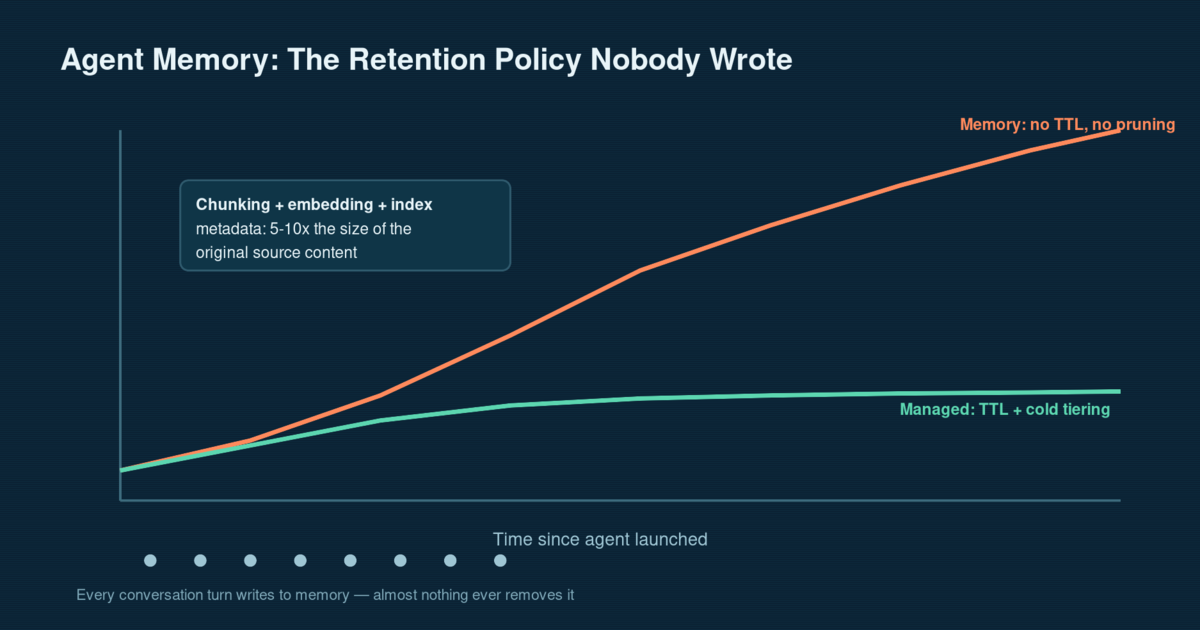
Every production database has a retention policy for something — logs roll off after 90 days, session data expires, old backups age out. AI agent memory usually doesn’t have one, because it wasn’t designed as data to be managed; it was designed as a feature to make agents seem smarter over time. The result is a vector store that grows in a straight line for as long as the agent runs, with no natural ceiling and, in most deployments today, no one who owns the decision to prune it.
What’s actually happening
“Agent memory” — the practice of embedding conversation turns, task outcomes, retrieved documents, and self-reflections into a vector store so an agent can recall them in future sessions — has become a default architectural pattern almost as fast as RAG itself did. The pitch is straightforward: an agent that remembers what happened last time is more useful than one that starts cold every session. What gets built less often is the other half of that architecture: a policy for what memory stops being worth keeping.
The storage math is worse than it looks at first glance. Analysis of vector database storage economics in 2026 points out that chunking, embedding, and index metadata routinely multiply the footprint of source content by 5 to 10 times — a megabyte of raw conversation or document text can become 5 to 10 megabytes once it’s chunked, embedded at whatever dimensionality the model uses, and indexed with the graph or tree structure most vector engines need for fast approximate search. That multiplier applies to every turn an agent writes to memory, not just the useful ones, because most agent memory systems don’t distinguish between a high-value fact worth keeping indefinitely and a routine exchange that has no value forty-eight hours later.
Pricing structure compounds the problem rather than capping it. A 2026 vector database pricing comparison notes that managed vector stores bill on a mix of storage (per GB-month of vectors), queries, and writes — and that RAM-backed indexes, which most teams reach for by default because they’re fast, run roughly 10 to 50 times more expensive per GB than SSD-backed storage, which itself runs roughly 10 times more than object storage. An agent memory system that started on a RAM-backed index for good reasons (low query latency matters for a chat-facing agent) inherits the most expensive possible cost curve for a workload that, by definition, only grows.
This is a different failure mode from the database billing-minimum problem created by spiky agent query patterns or the attribution blind spot in agent-driven warehouse spend. Those are consumption problems — cost that scales with how much agents query. Unbounded memory is a retention problem — cost that scales with how long agents have existed, independent of whether anyone is actively using what’s stored. A query-cost problem shows up as a spike; an unmanaged memory-retention problem shows up as a monthly line item that never goes down, on a system nobody remembers provisioning for this purpose.
Who this affects
Data platform and ML infrastructure teams own the vector stores where this accumulates, and they’re usually the first to notice — not because a dashboard flags it, but because a storage tier that was sized for a pilot is suddenly an order of magnitude larger six months later. Because most vector database monitoring is built to track query latency and recall quality, not storage growth trend lines, this tends to surface as a surprise rather than a forecast.
Product and applied-AI teams who own the agent’s memory design are responsible for the actual retention decisions, even when they haven’t consciously made one — the default in almost every agent framework and memory-as-a-service product today is “keep everything,” which is a retention policy, just an unexamined one. FinOps and cloud cost teams inherit the bill without necessarily having visibility into why a vector index keeps growing, especially if memory writes are scattered across many agent instances or customer tenants rather than consolidated somewhere obviously attributable.
CTOs and engineering leaders carry the compounding risk: a memory store that’s 2x too large this quarter is an inconvenience; the same store at 20x, two years into an agent product’s life, is a re-architecture. And compliance and data governance teams have a parallel exposure that’s easy to miss in a pure cost conversation — indefinitely retained conversational memory that includes customer data is also indefinitely retained personal data, which is its own liability under data minimization requirements in regulations like GDPR, independent of what it costs to store.
When this becomes a hard problem
This is already underway, not a future risk. The AI agent memory market itself is projected to grow from roughly $6.27 billion in 2025 to $28.45 billion by 2030, a compound annual growth rate above 35% — which means the number of production systems writing to long-lived agent memory stores, and the volume each one accumulates, is scaling faster than most FinOps processes are built to track. IDC’s FutureScape 2026 CIO and CTO agenda forecasts that Global 1000 organizations will underestimate AI infrastructure costs by roughly 30% through 2027, specifically because forecasting models built for predictable compute don’t capture costs unique to AI-specific patterns — unbounded, ever-growing memory storage is a textbook example of a cost that doesn’t show up in a traditional infrastructure budget line.
The realistic timeline runs on two tracks. For any individual agent deployment already in production with memory enabled, the cost curve is accumulating today — it’s linear, quiet, and currently small enough at most organizations to be absorbed without anyone noticing, which is exactly what makes it dangerous. At the industry level, expect the next 12 to 18 months to bring the same reckoning that happened with data lake storage a decade ago: a period where “just keep everything, storage is cheap” collides with the reality that storage isn’t actually cheap at the volumes agentic systems generate, followed by a wave of retention-policy tooling and vendor features built specifically to address it. Organizations that build a pruning discipline into their agent memory architecture now are ahead of that wave; organizations that wait will be doing memory audits under budget pressure instead of as routine hygiene.
How this actually plays out in a real environment
An agent with memory enabled writes to its vector store on some regular cadence — every conversation turn, every completed task, every retrieved document it deems worth remembering, sometimes every intermediate reasoning step if the memory architecture is granular. None of these individual writes are large. The problem is that almost nothing in a typical agent memory pipeline ever removes anything. There’s no TTL by default in most vector database schemas used for this purpose, no automatic demotion of low-relevance memories to cheaper cold storage, and — critically — no clear owner for the judgment call of what’s safe to delete, because deleting the wrong memory can visibly degrade an agent’s behavior in a way that’s easy to notice and blame, while carrying too much memory forward just quietly costs money in a way that’s easy to ignore.
Multi-tenant agent products make this considerably worse. If a memory store isn’t cleanly partitioned per customer or per agent instance, growth is aggregate and attribution is close to impossible — which connects directly to the same multi-tenant isolation weaknesses already documented in shared vector databases: a system architected without hard tenant boundaries for security reasons usually also lacks the boundaries needed for per-tenant cost and retention accounting. Add the kind of silent embedding drift that already happens after model upgrades, and teams often end up re-embedding and storing an entire memory corpus in a new vector space alongside the old one rather than migrating in place — because a clean migration is more engineering work than a fresh re-embed — which can double the storage footprint overnight for a system that was already growing unchecked.
The index-type decision compounds all of this. Teams generally pick a fast, RAM-resident index (HNSW-style, in-memory) when they’re optimizing for a chat-facing agent’s response latency, which is the right call for the working set of memory an agent actually queries frequently. But most agent memory systems don’t tier storage — the same expensive, low-latency index holds a customer’s most recent conversation and a task summary from fourteen months ago that will never be retrieved again, because nothing in the architecture distinguishes “hot” memory from “cold” memory and moves the cold portion somewhere cheaper.
Actions to take now
- Instrument storage growth on your agent memory stores today, separate from your general database monitoring. Most teams track query latency and recall quality on vector indexes; almost none track raw storage growth rate as its own metric. A simple month-over-month GB-growth chart, per memory store, will tell you in five minutes whether you have this problem.
- Define an explicit retention policy for agent memory, even a conservative one, rather than defaulting to “keep everything.” Start with something defensible — memory older than 90 days that hasn’t been retrieved gets archived or deleted — and refine it against real usage data rather than guessing at the right window up front.
- Tier your storage by access frequency. Move memory that isn’t retrieved regularly out of RAM-backed indexes into SSD- or object-storage-backed tiers, which can cost an order of magnitude less per GB. Most vector database platforms and managed services now support some form of tiering; if yours doesn’t, that’s worth weighing in your next platform evaluation.
- Treat re-embedding events as a storage-cleanup checkpoint, not just a model upgrade. When you move to a new embedding model, decommission the old vectors on a defined schedule instead of letting two full copies of memory coexist indefinitely.
- Partition memory storage per tenant or per agent instance from the start, so growth and cost are attributable and a retention policy can be applied — and enforced — at the tenant level rather than only in aggregate.
- Loop in data governance on memory retention, not just cost teams. Indefinitely retained conversational memory is indefinitely retained personal data in many cases; a retention policy built purely for cost reasons will often satisfy a compliance requirement you also need to meet, but only if governance is at the table when the policy is written.
- Budget agent memory storage as its own forecastable line item, with a growth-rate assumption baked in, rather than folding it into general database or vector-database spend where its trajectory is invisible until it’s already large.
Key takeaways
- AI agent memory systems default to indefinite retention, and vector database chunking, embedding, and indexing overhead can multiply the storage footprint of that memory 5 to 10 times over the raw source content.
- This is a retention-cost problem, distinct from consumption-cost problems like query-driven billing spikes — it grows with an agent’s lifetime, not with how actively it’s used.
- RAM-backed vector indexes, the default choice for latency-sensitive agents, carry the highest possible per-GB cost for a workload that only accumulates and rarely shrinks.
- Multi-tenant agent products without hard tenant boundaries in their memory stores usually can’t attribute or control this growth per customer, compounding the problem.
- Expect retention-policy tooling for agent memory to become a mainstream FinOps and vector-database vendor feature within the next 12 to 18 months; building the discipline now is cheaper than a retroactive memory audit later.
Get ahead of it
Agent memory that never expires isn’t a feature, it’s an unmanaged liability sitting on your storage bill. If your team can’t currently answer how fast your vector stores are growing or what happens to memory that’s a year old, that’s the gap to close first. Get in touch if you want help auditing your agent memory architecture and putting a retention and tiering strategy in place before the storage curve gets expensive to unwind.
Ivan Lima is a data engineer specializing in database modernization for AI systems. Get in touch if your database needs to be ready for what’s next.